20. The Bayne House
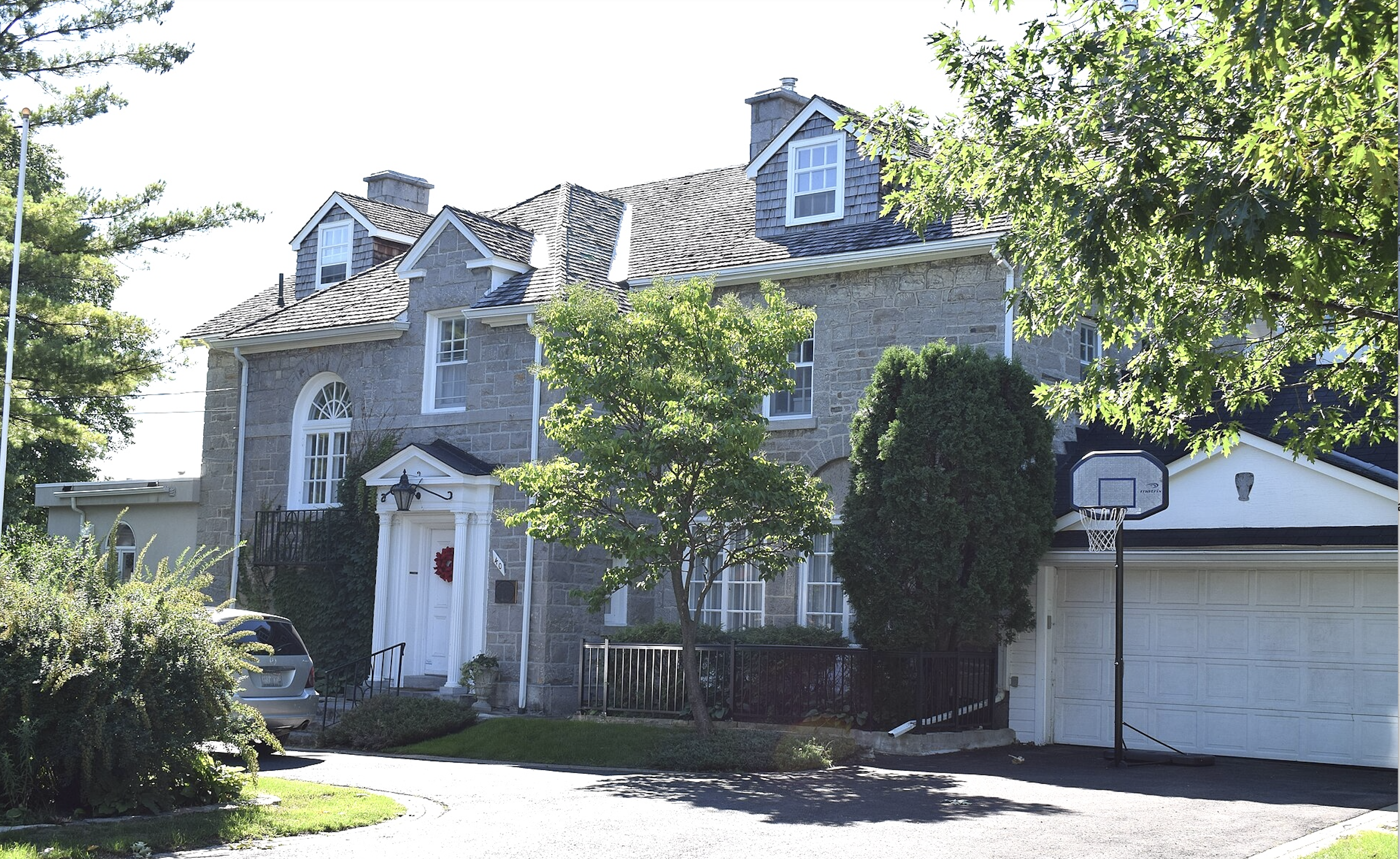
This handsome stone house is a profile of Ottawa’s beginnings in the early 19th century, before Bytown was even Bytown. The land in Nepean Township was purchased by one George Bayne for his sons Robert and John. George was a Scot who had worked for Redpath and McKay, contractors on the Rideau Canal construction. Today, the house is nestled in the Civic Hospital neighbourhood at 40 Fuller Street.
Documentation indicates that the Baynes were living at this location in a log house as of the mid 1820s; around this time the log building was replaced by a fine stone house. It appears that the original house was 1 1/2 storeys, with a centre door, typical of stone houses constructed throughout eastern Ontario at this time. The original builder was Corporal William Ross, a stonemason working under Lt. Col. John By on the construction of the Rideau Canal. Many of the stonemasons from Scotland and Ireland who worked on the Canal stayed on, and we owe them a tremendous debt for the splendid stone buildings – houses, mills, churches – that they bequeathed us, not just in Ottawa, but in neighbouring communities throughout eastern Ontario.
At the time of its construction, the Bayne house was actually in Nepean, a settlement to the west of Bytown. Early development in Nepean was based upon agriculture, seasonal work in the lumber industry, as well as inns catering to travellers between Bytown and more distant settlements such as Bells Corners, Richmond and Perth. Later in the 19th century after Bytown became Ottawa, this area was developed for suburbs supporting a growing Ottawa, and featured handsome suburban villas, such as the Bayne House. (For more on the contextual development of this area of Ottawa, we recommend Professor Bruce Elliott’s outstanding work, The City Beyond: A History of Nepean, Birthplace of Canada’s Capital 1792-1900.
The building’s unusual appearance today is the result of decades of growth and change. In 1929, the Morrisons, owners of the Morrison Lamothe bakery, purchased the property and transformed it into its current appearance. A new entrance was added, effectively turning the house around so that the original front façade faces the rear garden to the south. They made considerable upgrades, significantly investing in the ongoing value of this handsome and important structure, including the dormer windows on the roof, and the fine woodwork pediment and columns surrounding the new main entrance.
The Morrisons raised three daughters in the house who became prominent Ottawa women: Jean Pigott, Member of Parliament and later chair of the National Capital Commission (1985-1992), Gay Cook, beloved figure in Ottawa’s culinary community, food columnist and cookbook author, and Grete Hale, who became president of Morrison Lamonte Bakery, governor of the University of Ottawa, and honorary colonel of the Governor General’s Foot Guards. Both Grete and Jean were named to the Order of Canada.
The Bayne House was designated under the Ontario Heritage Act, and includes the building, its surrounding grounds and a stone well.
SOURCES
Grete Hale, Obituary, Ottawa Citizen, 8 November, 2022;
Ottawa Life Magazine, 11 May 2023;
Andrew Waldron, Exploring the Capital: An Architectural Guide to the Ottawa-Gatineau Region, (Vancouver, Figure 1 Publishing, Inc., 2017), p. 180;
“Bayne House”, Ottawa: A Guide to Heritage Structures, (Ottawa: LACAC, 2000);
City of Ottawa, Individually designated properties;
Bruce Elliott, The City Beyond: A History of Nepean, Birthplace of Canada’s Capital 1792-1900 (Nepean: City of Nepean, 1991).
