12. College of Bytown | Bishop’s Palace
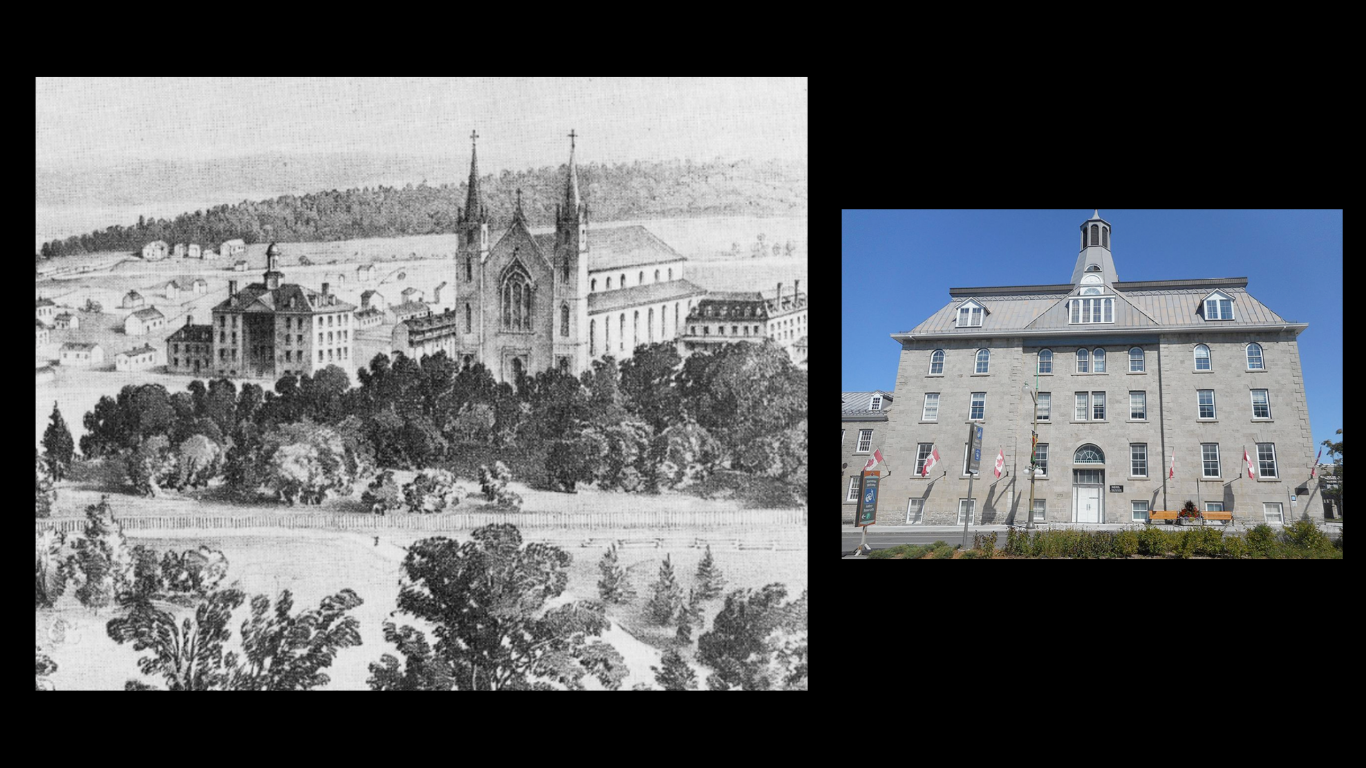
Ottawa’s first bilingual school for boys, the College of Bytown dates to 1848. Founded by the first Catholic bishop of Bytown Monseigneur Guigues, the stone structure at 373 Sussex Drive was completed in 1853, replacing a drafty, wooden building nearby. The new college incorporated the adjacent Bishop’s Palace as an annex. Together they form an important visual landmark on Sussex Drive and contribute to the character of the “Mile of History” in the nation’s capital.
The smaller and more modest Georgian-style Bishop’s Palace had served as Monseigneur Guigues’ residence. It is the oldest building on Sussex Drive, and one of the first stone residences constructed in Bytown after the Vesting Act of 1843, which permitted freehold sale of lands controlled by the Ordnance Department.
The more imposing yet graceful Georgian-style College of Bytown stands 3 ½ storeys with a dormered mansard roof topped by a distinctive octagonal cupola. The central 3 bays are slightly recessed and feature a tall, round-arched main door with multiple transoms. The quality of the ashlar walls and cut stone window lintels, corner quoins and end chimneys reveals the work of highly skilled stone masons.
In 1856, the College of Bytown moved to Sandy Hill, where it evolved into the University of Ottawa. The building on Sussex became the Champagne Hotel before being converted to military barracks in 1865. It returned to its academic role in the 1880s, and in 1898 was sold for $12,000 to the Christian Brothers who operated a private school called La Salle Academy.
By 1900, the Ottawa Citizen reported that La Salle Academy had "over 150 pupils and ten instructors” and that the building had been “fitted up anew, an extra storey and addition put on and the interior thoroughly remodelled and renovated.”
Plans for a new École Secondaire De La Salle on St. Patrick Street, part of the 1969 Lower Town Urban Renewal Project, put the historic building at risk. Concern intensified in 1971 after the move to the new site. Word leaked out that it had been sold to a group of Toronto developers planning an $8-million apartment complex.
Heritage Ottawa rallied public support for the property and in 1973 the federal government purchased the building for use as office space. The restoration of the former La Salle Academy, undertaken in 1975 by NCC architect and later Heritage Ottawa president John Leaning, saw important original features reinstated.
The building is still in use as the Canada School of Public Service. Public Services and Procurement Canada is currently undertaking repairs and restoration of the building with the aim of "preserving [its] heritage character over the long term.”
The property was designated by the federal government as a Classified Heritage Building in 1988, due to its important historic role in education.
Photo: Depictions of Bishop's Palace and Bytown College in 1855, at left of Notre Dame Basilica. Engraving by Edwin Whitefield / Library and Archives Canada
Sources
Ottawa Directory and Dominion Guide 1875. Ottawa: A.S. Woodburn, [1875].
Ottawa Citizen December 13, 1898, p. 5 and June 25, 1900, p. 7.
Heritage Ottawa, 50 Years | 50 Stories: 8. La Salle Academy
John B. O’Reilly, The College of Bytown, 1848-1856, CCHA, Report, 15 (1947-1948), 61-69.
"Repairs planned for La Salle Academy," Lower Town Echo, March 1, 2026
