26. Fleet Street Pumping Station
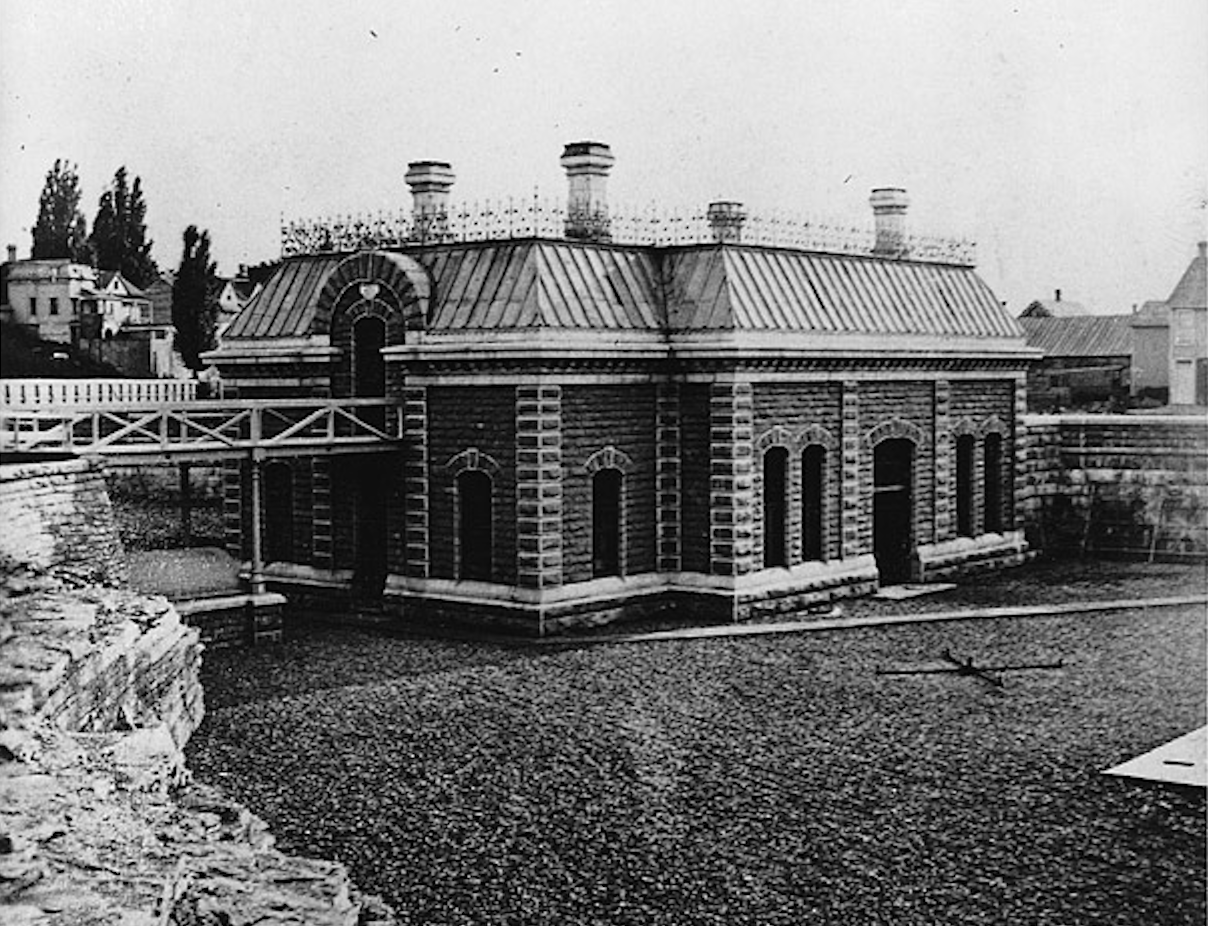
When Ottawa became Canada’s capital in 1857, the city had no reliable water supply. Barrels were filled with water from the Ottawa River and delivered around town by horse-drawn carts. To supply the new parliament buildings, a pump house was built in 1865 at the water's edge to pump river water to tanks in the six corner towers of the centre block and attics in the east and west blocks.
By the 1870s the need for a reliable drinking water was urgent, so the city built a pumping station on Lebreton Flats. It was designed by civil engineer Thomas Coltrin Keefer, who had built steam-powered water works for Montreal and Hamilton. He was also a prominent canal and railway engineer.
Keefer's design for the pumping station on Queen Street West, (later Fleet Street), used water from the Chaudière Falls to drive two pumps, supplying the principal water mains east along Wellington and Slater streets and west to Lebreton Flats. The limestone water works opened in 1874, fed by an open aqueduct from Nepean Bay, with drinkable water from further out in the river carried via a pipe on the bottom of the aqueduct. From the pumps the aqueduct water flowed under Pooley's Bridge and via the Tailrace back to the Ottawa River.
The pumping station was expanded in 1888 by Keefer's former assistant, Robert Surtees, then city water works engineer. As Ottawa city engineer, he had designed the new courthouse in 1871, (now Arts Court). His other works included the Hull, Peterborough and Arnprior water works, hospital expansions and the Minto Bridges. Surtees' water works expansion followed Keefer's style but added space for up to four more pumps and in 1899-1901 a second floor for storage.
In 1912 further expansion required a more reliable water supply for the pumps. A covered aqueduct was constructed along Ottawa Street. It paralleled the open aqueduct, which remained as a secondary supply. The covered aqueduct is still the principal source of water to the five pumps which continue in use today. The clean water now comes from the Lemieux Island filtration plant. The historic Pooley's Bridge has been rebuilt for pedestrians and bicycles with the downstream side removed. The Tailrace has long been used for training Olympic kayakers.
The Water Works, together with the open aqueduct and its bridges, was designated under Part IV of the Ontario Heritage Act in 1982. Pooley's Bridge and the Tailrace were designated in 1995. The designations were updated in 2024. There is also a provincial heritage easement with the Ontario Heritage Trust. The Water Works has been open to the public for Doors Open weekend and is always a popular site to view this unique 150-year old operation.
References
Blair Crawford, "How 150-year-old technology keeps Ottawa's water flowing", Ottawa Citizen, 6 Nov. 2024
City of Ottawa, "Update to the Designation of the Ottawa Water Works Complex under Part IV of the Ontario Heritage Act", File Number: ACS2024-PRE-RHU-0017, Report to Built Heritage Committee on 13 February 2024 and Council on 21 February 2024.
Keefer, Thomas Coltrin, National Historic Person. Dictionary of Canadian Biography: https://
