5. Steamboat Landing
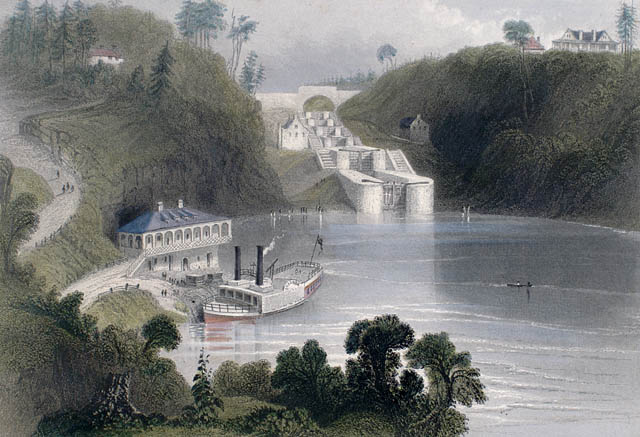
When Colonel John By arrived in the area in 1826, there were only two wharves on the Ottawa River. One served Wright's Town (or Wrightstown), on the north shore at the foot of what is now Hull's Rue de l'Hotel de Ville. There was a tavern and a storehouse there. The south bank of the river had Richmond Landing, serving the road built in 1818 to the military settlement of Richmond, and a private wharf, owned by Robert Drummond, at the foot of a ramp leading down from what would become Bank Street. A brewery had also been established adjacent to Drummond's Wharf.
Colonel By needed his own wharf for deliveries to the engineers' works yard at what is now Rideau and Sussex, and to the Ordnance and Engineers Building and Commissariat by the locks. Before By's arrival, steamboat operator and contractor Robert Drummond had already built the first lock on the Ottawa River at St. Anne de Bellevue. Construction was also underway by the Royal Engineers at Grenville on a canal to bypass the rapids at Carillon, making Ottawa reachable by steamboat from Montreal.
The new wharf became known as "Steamboat Landing". Steamboat use influenced By's design for the canal. Originally the locks were specified for a width of 20 feet and length of 108 feet. This size was suitable for horse-drawn barges as operated on the earlier Erie canal. For steamboat use, however, By recommended 50 by 150 feet. Eventually 33 by 134 feet was authorized.
When the canal was completed in 1832, Colonel By's first transit, with his family, the contractors and numerous dignitaries, was on Drummond's steamboat “Rideau," built at Kingston and renamed “Rideau.”
The first access roadway wound its way up the hill past By's house, through what is now Major's Hill Park. When the streets of Lower Town were laid out, St Patrick Street was extended down to the Landing. The first building appears to have been a hotel with a second floor veranda. It was soon replaced by a long stone building, which by 1863 was taken over by George Stirling, to be operated for many years as Dominion Brewery.
A regular steam ferry service to the Hull landing was established, which continued for many years, even after the bridge at the Chaudière opened in 1828 and from 1838 to 1842 when it collapsed. The ferry captain's house was also built adjacent to the wharf. Ferry service ended when the Alexandra Bridge opened in 1901. When the railway connection to the bridge was built, access to the wharf was maintained under a 91.5-metre (300-foot) long steel railway viaduct, but the former ferry captain's house had to be moved down to the wharf and the brewery building was progressively demolished.
The wharf continued to be used for freight and to moor the tugboats that served the logging industry on the river and barge traffic on the canal. By 1965 there was a small marina. However, the main steamboat traffic moved to Queen's Wharf, which was built downstream from Nepean Point. By the 1970s all traces of the former Landing and the marina had been removed.
Photo: W.H. Bartlett, c.1840, LAC/C-002367, based on his watercolour sketch, LAC/C-040355
