22. The Story of Abbotsford
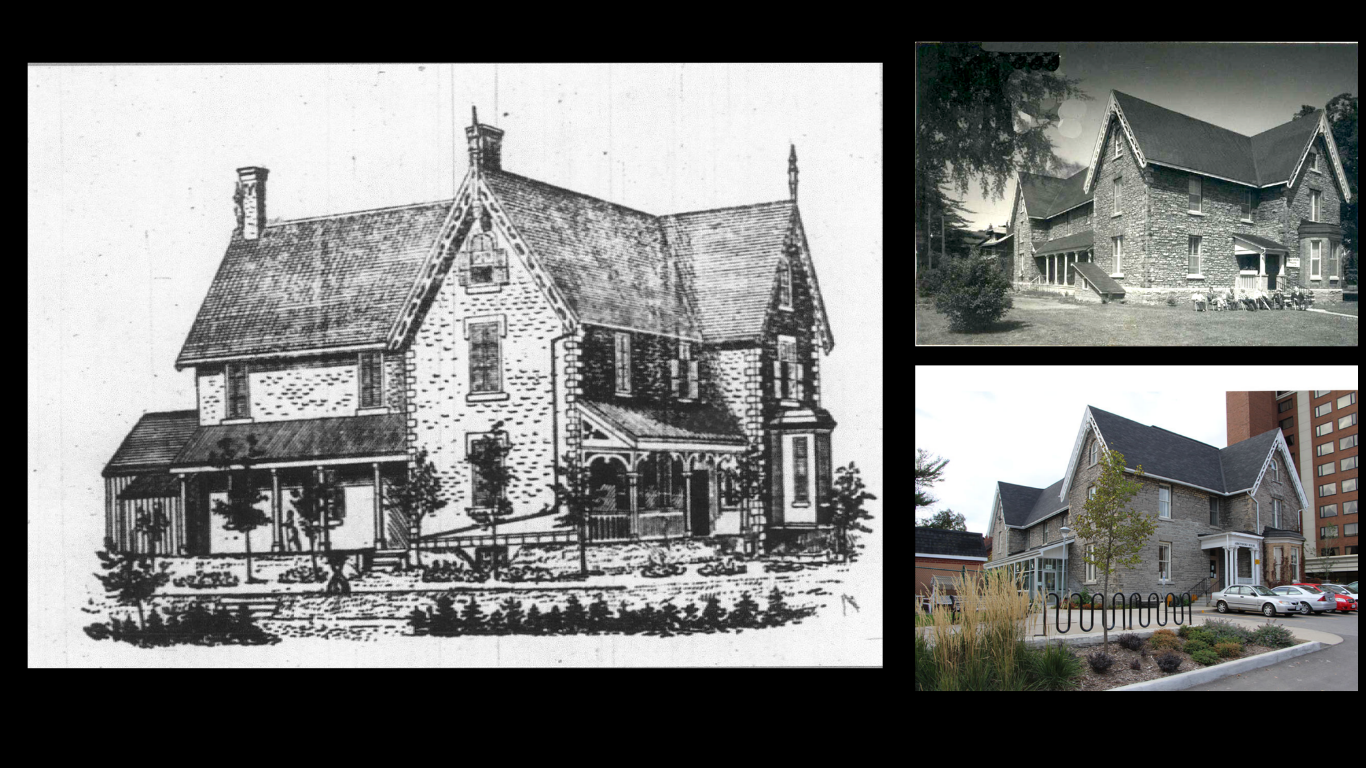
In his preface to the 1864 Ottawa Directory, Dr. S.C. Sewell wrote: "12 years ago, the number of stone houses did not exceed 25. All except two or three of the coarsest rubble work. Now they may be counted by hundreds. Black Trenton (limestone) with Nepean sandstone dressings for gentlemen's houses, chiefly in the Tudor style, is much in vogue and the effect is very pleasing." Abbotsford would be one of these houses.
In the early 1800s the Mutchmor family, from Glengarry County, acquired about 200 acres south of the Glebe and north of the future Lansdowne Park. It was not until 1861 that young Alexander Mutchmor came to Ottawa where, with his cousin and business partner John M. Garland built an imposing dry goods store on Sparks Street in 1864. That same year, he and his two brothers inherited the Ottawa property from their father John Mutchmor.
When in 1865-1867, Bank Street was extended to Billings Bridge and macadamized (then known as Bank Street Road), with a swing bridge over the canal, the area became attractive for new development.
Alexander built Abbotsford at 954 Bank Street around 1867 in a Tudor style of stone to a pinwheel plan with one gable facing each compass direction. The architect is unknown, however about 10 similar houses were built around Ottawa within the decade, the first being Earnscliffe around 1857, later home to Sir John A. Macdonald. At least seven architects emigrated from England between 1855-1860 who designed Tudor or Gothic Revival buildings in Ottawa. Stent and Laver, architects of the East and West Blocks, designed Garland and Mutchmor’s Sparks Street store.
Abbotsford was named for the Gothic castle built 1817-1825 by Scottish author Sir Walter Scott and considered home to the romantic novel. Curiously, it has the same name as a character and lairdship in one of Scott's novels.
Other houses soon followed in the area between 1869 and 1872, including Echo Bank (700 Echo Drive) for George Hay, Elm Bank (near today’s Sunnyside Public Library branch) for Thomas McKay, and one or two houses on the Mutchmor land, including 910 Bank (where the present day Beer Store is located) for Alexander’s partner John Garland.
In 1868 the Ottawa Agricultural Society purchased an agricultural fairground south of Mutchmor's land. In the 1880s it was named for Governor General the Earl of Lansdowne and became home to the Central Canada Exhibition. The city added part of Mutchmor's land for the later construction of the Coliseum. Abbotsford now faces Lansdowne Park, towards the 1898 Aberdeen Pavilion.
Garland and Mutchmor were bankrupt in 1879 and sold their homes, Abbotsford to Ottawa Citizen publisher and mayor Charles Mackintosh. Garland remained in Ottawa with a new business but Alexander moved to the family home at Caledonia. He returned to Ottawa, but not to Abbotsford, with his large family around 1891, and died age 59 five years later. Charles Mackintosh lived at Abbotsford until 1889, then sold it to the Protestant Home for the Aged. He moved to another stone mansion in Sandy Hill and then, as Lieutenant Governor, to the Northwest Territories.
In 1895 Abbotsford was enlarged by the prominent architect James Mather, with a matching west wing to frame the south-facing verandah. Renamed Abbotsford Haven in 1967, it became part of the Glebe Centre in 1972, housing women as well as men. Since 1975 it is Abbotsford House Seniors Centre, serving the community and the modern residence to the south.
The original 1872 portion of Abbotsford was designated under Part IV of the Ontario Heritage Act in 1984.
