7. Colonel By’s Town Plans and Street Naming
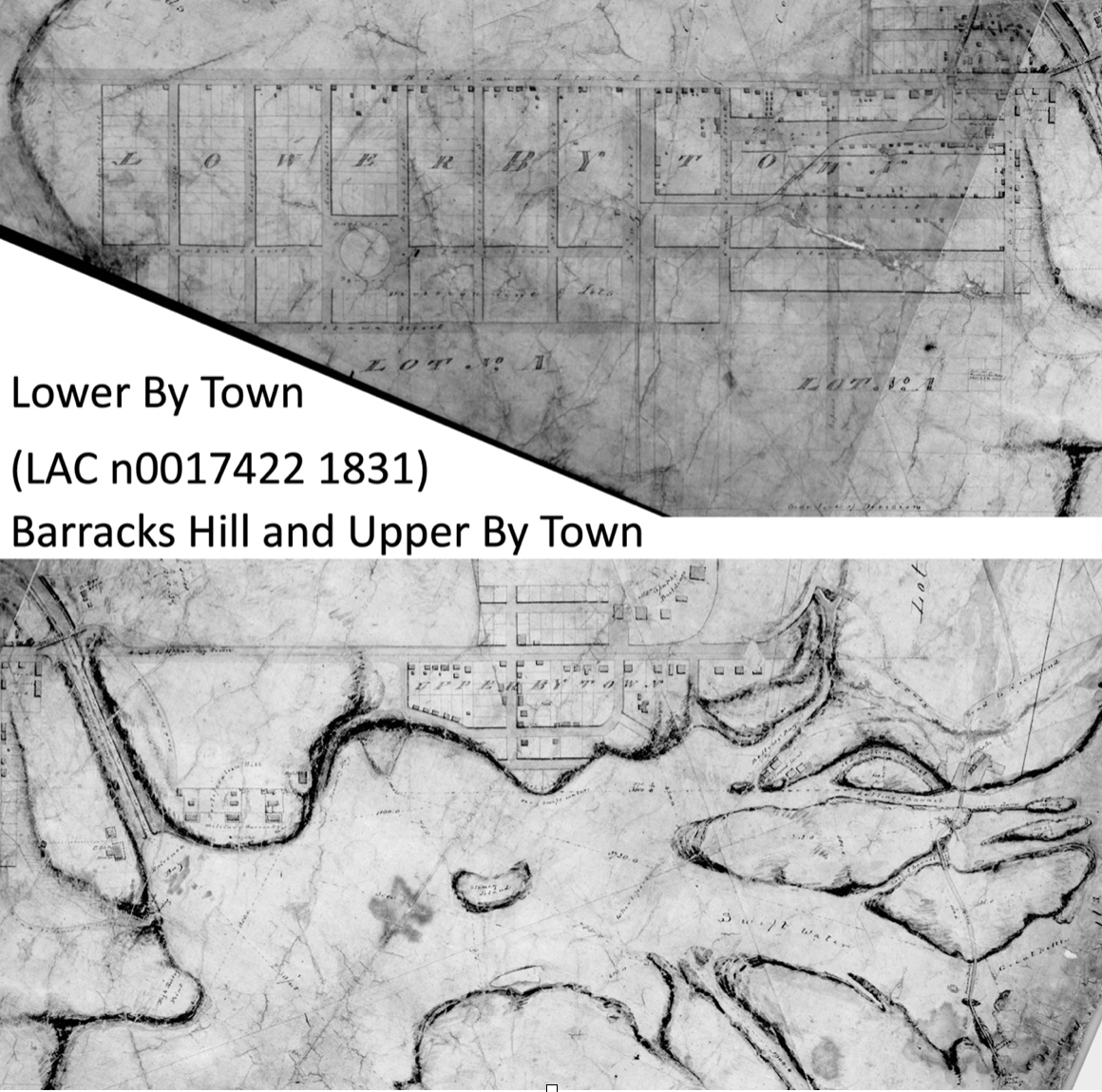
Lord Dalhousie, Governor General of British North America in the 1820s, acquired land in the area surrounding the Rideau Canal entrance on behalf of the British Ordnance. It was this land that Colonel John By used to set out two communities on either side of the canal: Lower By Town, east of the canal, and Upper By Town, west of Barracks Hill. Between 1826 and 1828, he drew up settlement plans, naming most of the streets after the children of King George III.
The plans intentionally divided communities along ethnic, social and economic lines, separating the primarily French Canadian and Irish Catholic canal labourers and lumbermen on the drained marshlands of Lowertown from the English and Scottish Protestant elite, made up of government officials and merchants, on the higher rocky plateau of Upper Town.
Colonel By laid out the streets of Lowertown using a grid pattern running east and west of the present King Edward Avenue. Two wide streets to the west provided markets, with the first market houses in the middle of George Street (named in honour of King George IV) at Sussex Drive (named for his brother, Prince Augustus, Duke of Sussex). By Ward Market Square and William Street came later. The street pattern established in the 1820s is still largely recognizable in Lowertown west today.
To the east, a public square also housed a market. In 1845, Roman Catholic, Methodist, Presbyterian and Anglican cemeteries were created, today the heritage-designated Macdonald Gardens Park. A Methodist chapel was built in 1826-1827 and later a Roman Catholic church, further north along Sussex Drive.
Upper By Town consisted of large lots for army officers and wealthier residents. Nicholas Sparks, for whom Sparks Street is named, had purchased 200 acres of land in what is now downtown Ottawa in 1821. He subdivided part of his land south of Wellington Street (named in honour of the Duke of Wellington), with the first St. Andrew's Presbyterian Church at Hugh (later Kent) Street, a market square at Sally (later Lyon) Street, and a Methodist chapel and Anglican church on Sparks Street. Upper By Town's main streets were Wellington, Kent and Vitoria, running from the market to the future Bank Street.
A visitor to Bytown in the summer of 1828, Joseph Bouchette, left a written account describing the settlement: “The streets are laid out with much regularity, and of a liberal width that will herafter contribute to the convenience, salubrity and elegance of the place. The number of houses now built is about 150, most of which are constructed of wood; frequently in a style of neatness and taste that reflects great credit upon the inhabitants.” (As quoted by Robert Legget in Rideau Waterway).
Street Name Origins
Lower By Town (west)
- George Street: King George IV. (King Street became King Edward Avenue).
- York Street: Prince Frederick, Duke of York and Albany.
- William and Clarence streets: Prince William, Duke of Clarence, King William IV after 1830.
- Cumberland Street: Prince Ernest, Duke of Cumberland.
- Sussex Drive: Prince Augustus, Duke of Sussex.
- Dalhousie Street: George Ramsay, 9th Earl of Dalhousie, Governor General of British North America 1820-1828.
Lower By Town (east)
- Nelson Street: Admiral Horatio Nelson, died at the battle of Trafalgar, 1805
- Gloucester Street (now Friel Street): Prince William, Duke of Gloucester and Edinburgh, nephew of King George III.
- Chapel Street: Methodist Chapel, Rideau at Chapel, built 1826-1827, burned 1828.
- Augusta Street: Princess Augusta.
- Cobourg Street: Princess Victoria of Saxe-Coburg-Gotha, wife of the Duke of Kent and mother of the future Queen Victoria. (Born and married in Coburg, Germany).
- Wüttemberg Street: Princess Royal, Queen consort of Württemberg, Germany.
- Anglesey Square: Henry Paget, Marquess of Anglesey, Master General of the Ordnance 1827-1828, (Colonel By's superior. Anglesea Square became Jules Morin Park).
- Franklin Street (now Clarence Street East): Sir John Franklin, arctic explorer, laid the first stone for the locks in 1827.
- Parry Street (now Clarence Street): Sir William Edward Parry, arctic explorer.
Upper By Town
- Wellington Street: Arthur Wellesley, Duke of Wellington, Master General of the Ordnance 1818-1827 (Colonel By's superior, later Prime Minister).
- Kent Street: Prince Edward, Duke of Kent and Strathearn, father of the future Queen Victoria, died 1820. First member of the Royal Family to live in Canada (1791-1800).
- Vitoria Street: Battle of Vitoria, Spain, won by Wellington in 1813. (Sometimes Victoria, now Vittoria).
