28. St. Andrew’s Presbyterian Church
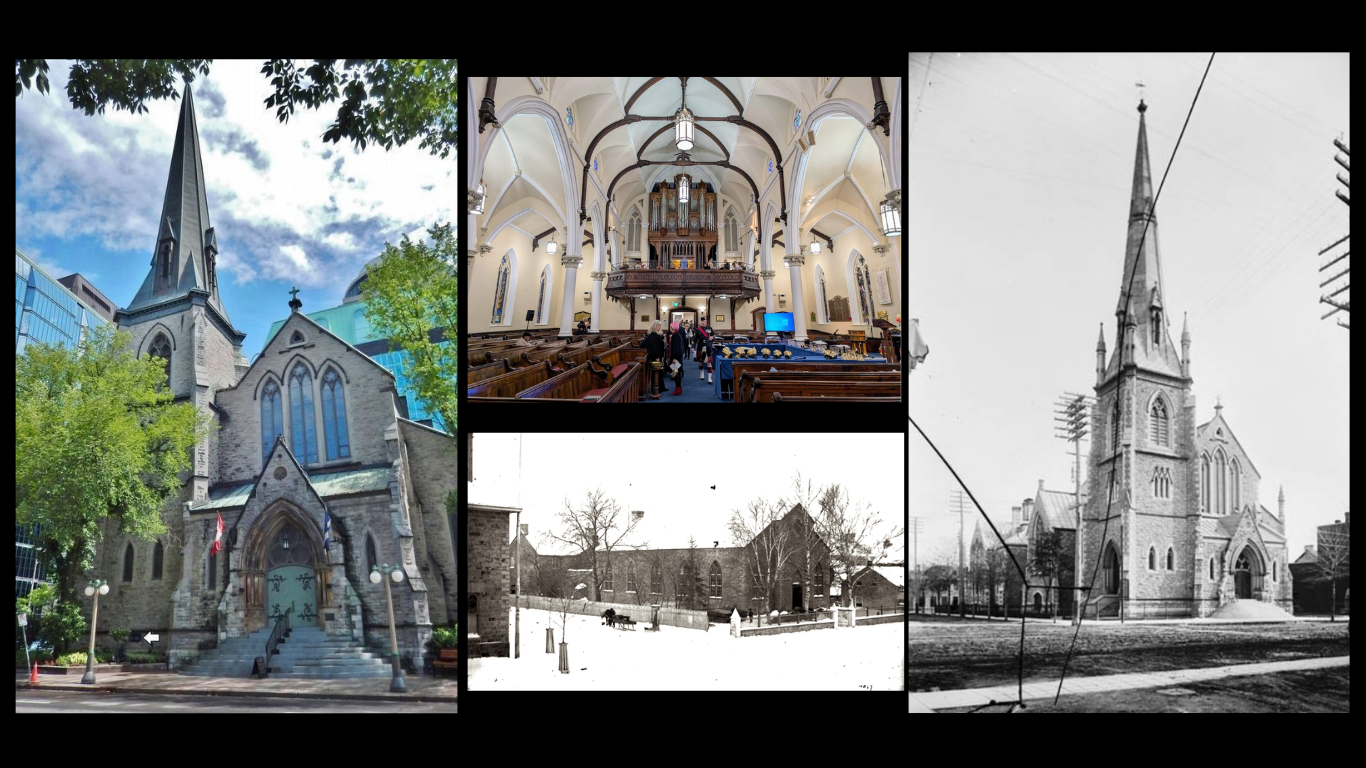
Located at the corner of Kent and Wellington streets, St. Andrew's Presbyterian Church was the first church established in Upper Bytown. Thomas Mackay, contractor for the Rideau Canal, and three associates purchased the lot from Nicholas Sparks for £200. MacKay also donated the stone and the work of his skilled stone masons to erect a simple building, 17 by 14 metres, accommodating 300 persons that opened in 1828. It was described in 1869 as "void of all architectural beauty and ornament on the exterior, [but] nevertheless a neat, commodious and in every way comfortable Church within.”
A manse for the minister was built behind the church in the early 1840s. In 1854, the church was extended from three window bays to five. By 1872, the congregation outgrew the space, and the church was replaced with a much grander structure designed by Montreal architect William Tutin Thomas. He had apprenticed to his father, prominent Toronto architect William Thomas, who designed about 12 churches in Toronto and other Ontario cities.
Completed in 1874, the asymmetrically placed tower and steeple is typical of the high Victorian Gothic style adopted by the Ecclesiological movement in England, birthplace of William Tutin Thomas and his father. The architectural plan includes Gothic features such as lancet windows, modified buttresses and tracery, but with a relative severity of style and flat surfaces. Inside, the orientation of pews is typical of churches of the reformed tradition that emphasize readings, sermons and prayers, and the role of the minister as leader of worship. The high pulpit, the central architectural focus of the interior, emphasizes this tradition. Later the Sunday School replaced the old manse.
William Tutin Thomas had supervised building two of his father's churches in Hamilton in the 1850s. He is noted in Montreal for Saint George's Anglican Church (1869) on Peel St., four churches in eastern Canada, and many residential and institutional buildings in Montreal. In 1874 he also designed the Ottawa Collegiate Institute, the oldest part of Lisgar Collegiate.
Thanks to the influence of Thomas Mackay in the Legislative Assembly of Upper Canada, in 1837 the glebe land situated between Main St. in Ottawa East and Bronson Ave. (178 acres) was unusually allocated to St. Andrew's, rather than to the Anglican, (but later established) Christ Church. The ‘Glebe’ was eventually developed and sold in stages between 1890 and 1946, raising $750,000 to cover church debt, with funds to spare.
St. Andrew's has been the place of worship for many prominent Ottawa citizens: the Alexander Fleck family, Ottawa's leading iron founder, electrical entrepreneur Thomas Ahearn, who donated the stained glass Dorcas window that represents acts of charity by Lilias Fleck and her daughter Lilias Fleck Ahearn. There are about twelve more important stained glass windows in the church.
Today, St. Andrew’s is the only non-government property on Wellington Street. The site of the former manse and Sunday School was redeveloped in 1987 as an office building which now houses the federal Department of Justice. The church retained ownership of the land, leasing the air rights for 75 years. St. Andrew's is a popular venue for concerts because of its horseshoe-shaped seating arrangement for up to 650 persons, outstanding acoustics, and 1987 pipe organ.
St. Andrews was designated heritage by the City of Ottawa in 1980 as it "maintains the character of the 19th century in the heart of the contemporary urban core of the Nation's Capital".
Sources
Sutherland's City of Ottawa Directory for 1869-70, Library and Archives Canada, nlc008148, page 101.
Alastair Sweeney, "Thomas Mackay: The Laird of Rideau Hall and the Founding of Ottawa", University of Ottawa Press, 2022.
Glen McArthur and Annie Szamosi, re: William Tutin Thomas in "William Thomas, Architect", Archives of Canadian Art, 1996, pp. 128-138.
"St. Andrew's Presbyterian Church Heritage", Church website https://www.standrewsottawa.ca/who-we-are/heritage
"The Windows of Saint Andrew's Church, Ottawa", Church website, 2009. https://www.standrewsottawa.ca/stained-glass-windows
City of Ottawa Bylaw 79-80 "Designation of St. Andrew's Church", Ontario Heritage Trust, 1980.
