10. Notre Dame Cathedral Basilica
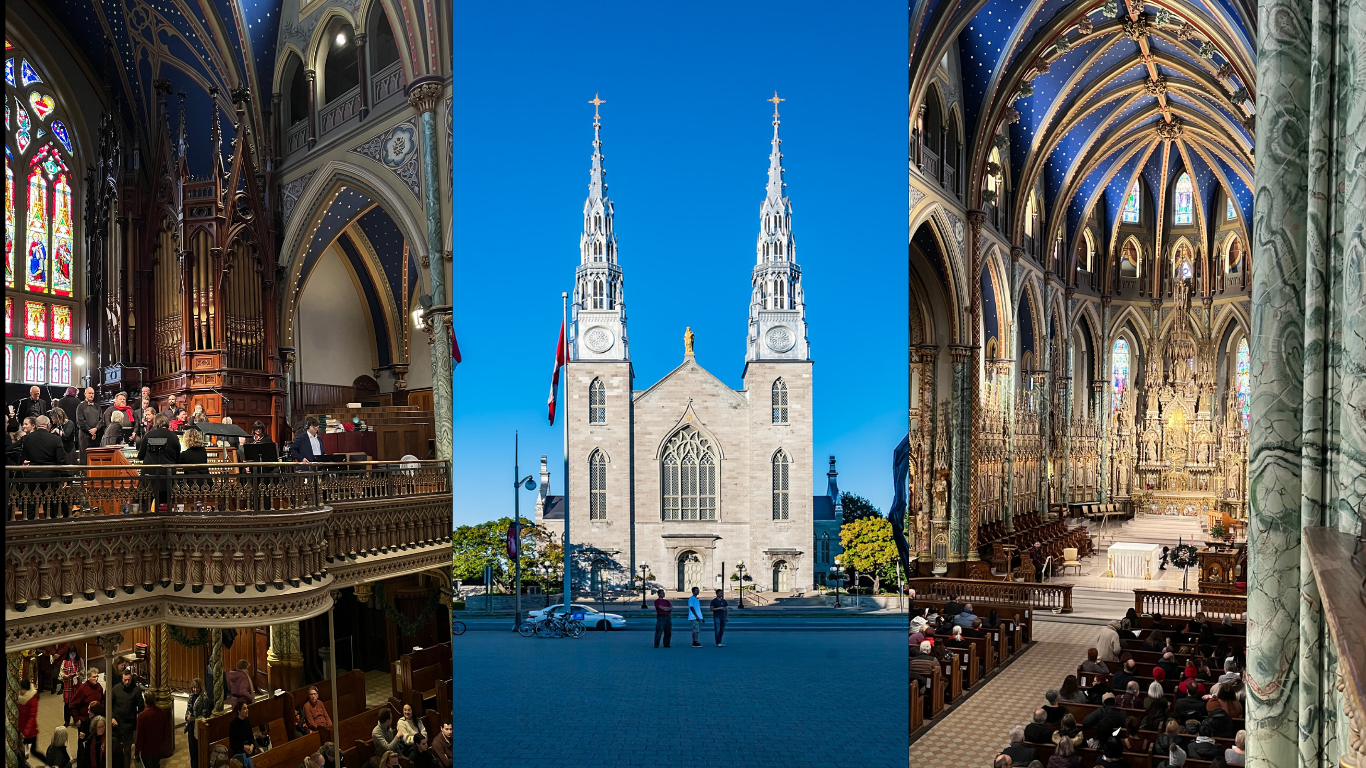
In 1841, when Ottawa was still muddy Bytown, construction began on one of its most ambitious and ultimately, most cherished structures that remains a dominant feature of Lowertown's skyline.
From the handsome limestone exterior façade we can see the transition of changing architectural styles imposed on the church's design over the years. The Neoclassical approach of local builder Antoine Robillard, under the authority of Father Cannon, is evident in the flat-headed ground floor doors. While above, the style transitions to the Gothic Revival, the choice of Father Pierre-Adrien Telmon who was influenced by its popularity in France. The pointed arches and spires of the main façade, and the ornate design of the twin cupolas are beautiful examples of this style.
The twin spires and gilded statue of the Virgin Mary and Child on the roof's peak formed landmarks for returning lumbermen and raftsmen on the Ottawa River in the 19th century, signalling their return to Bytown.
Notice the quality of the stonework, crafted by stonemasons who built the Rideau Canal. The tin roof is a classic feature of Quebec architecture, intended to protect the building from fire.
The main structure was completed in 1846, while work on the interior carried on until 1885.
And it is the interior that will astonish you. The sober, grey façade of Notre Dame does not prepare you for one of the most dazzling interiors in Ottawa – indeed, in the country. A team of master craftsmen of Quebec, headed by Philippe Hébert, created a symphony of splendour. Walk down the nave and side aisles and take in the intricate carvings and rich colour applied to all surfaces. Raise your eyes to the vaults, decorated with the stars of heaven. From there, make your way to the sanctuary, where 30 life-size statues line the perimeter. Embellishment continued throughout the 20th century, including the addition of a Casavant organ, stained glass windows by Guido Nincheri, culminating in the building’s sensitive restoration, undertaken in 1999.
Notre Dame is the central monument in a collective of structures important to the Roman Catholic community in Ottawa, which include the Archbishop’s Palace, the Grey Nuns Convent, and St. Brigid’s Church, all in Lowertown.
Notre Dame is the oldest surviving church in Ottawa and soon after construction began it was elevated to the status of the Cathedral of the Diocese of Ottawa (1847), followed by the honorific of basilica in 1879. The church has been the site of many significant events, including the funerals of former Prime Minister Sir Wilfrid Laurier, and of former Governor General Georges Vanier, and the visit of Pope John Paul II in 1984.
Notre Dame is also a key structure in a suite of nationally significant buildings that line Confederation Boulevard. This ceremonial route that defines official Ottawa links the capital’s most prominent sites, from the Justice Complex and Parliament Hill on Wellington Street, across the Rideau Canal to the Chateau Laurier and the former train station (now the Senate), and round the corner onto Sussex Drive where it continues past the Canada Revenue Building, the National Gallery, the Mint, Earnscliffe, several embassies, the Lester B. Pearson and John Diefenbaker Buildings, the National Research Council, and 24 Sussex, ending finally at Rideau Hall.
Notre Dame has two designations for its historic, architectural and environmental values: it is designated under the Ontario Heritage Act, and it is a National Historic Site of Canada. The church is open for services and to the public at no charge.
While you are in the neighbourhood, and if you want to see more Gothic Revival and more stunning wood carving, walk over to the National Gallery of Canada to see the interior of the Rideau Street Chapel, installed inside. The chapel interior was saved when the convent was demolished.
Photos: Commons: WikiLovesMonuments/Concierge.2C and C.F. Quinn
Sources
Norman Pagé, La Cathédrale d’Ottawa, (Ottawa: les Presses de l’Université d’Ottawa, 1988)
Statement of reason for designation (city of Ottawa), By-law #267-78 files (City of Ottawa) on historicplaces.ca.
Ottawa, a Guide to Heritage Structures, City of Ottawa, 2000
Andrew Waldron and Peter Coffman, Exploring the Capital: An Architectural Guide to the Ottawa-Gatineau Region, (Vancouver and Ottawa, 2017) and available in French from University of Ottawa Press
Katherine Fletcher, Capital Walks: Walking Tours of Ottawa, 2nd ed., (Markham, Fitzhenry & Whiteside, 2004).
