11. Thomas Brûlé House
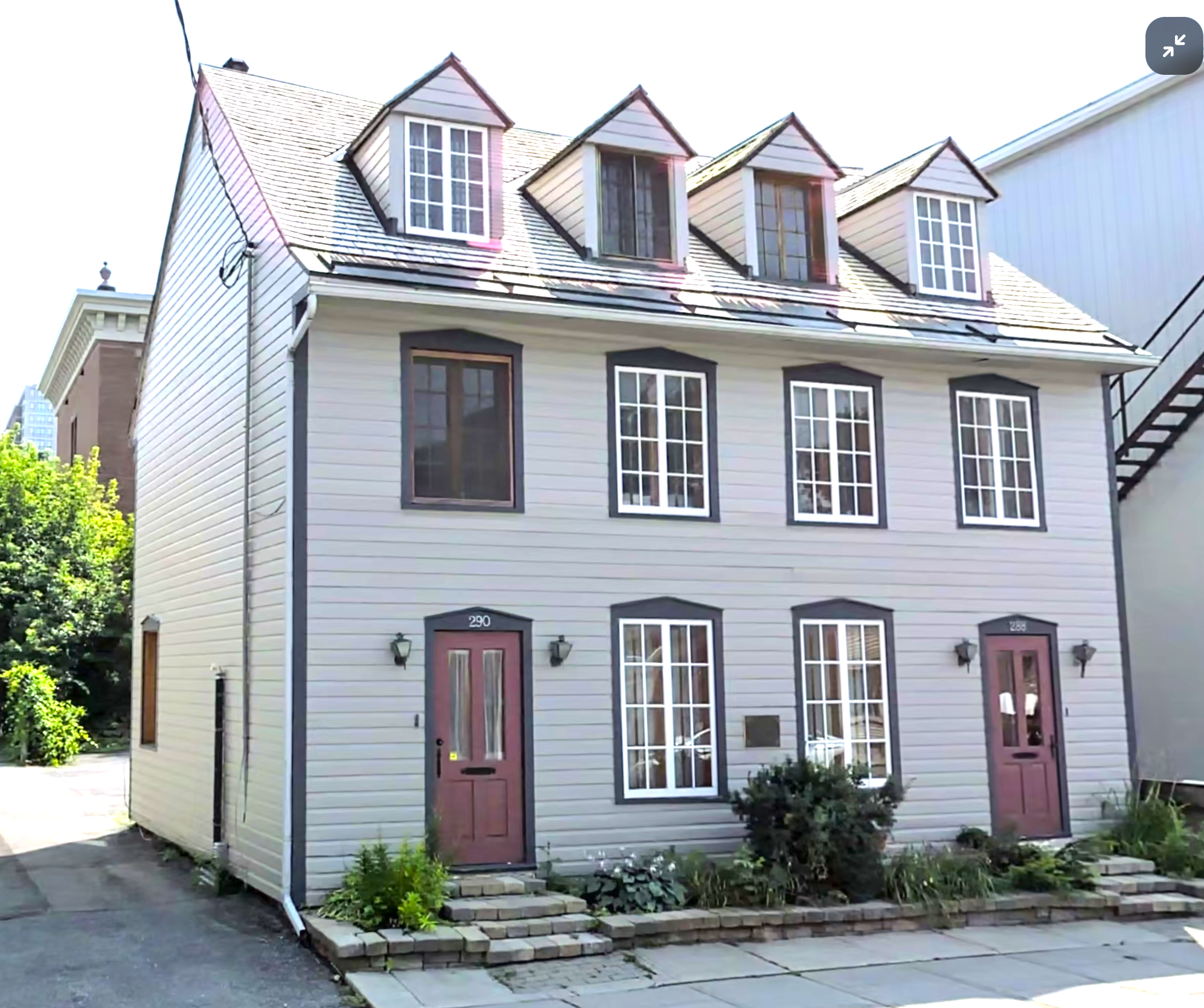
For much of the 19th century, small wooden houses dominated the landscape of Lowertown. This charming double at 288-290 St. Patrick Street was built by local blacksmith Thomas Brûlé around 1846, and has survived intact for some 180 years.
Brûlé House is a handsome, 2 1/2 storey, four-bay, side-gabled structure with a pitched roof. The simplicity of construction and use of wood siding is typical of vernacular housing in Lowertown in the lumbering era. Its symmetry, rectangular form and horizontal character speak to a pre-Victorian Georgian design tradition, while the overhanging roof, four dormer windows, and large eight-paned pedimented windows, inviting natural light into the interior, reflect the French-Canadian style.
The story of this house that is not visible from the street is its direct connection to the infamous Stoney Monday Riot of 1849. Thomas Brûlé gained some notoriety in connection with the riots when he was accused and tried on a charge of murder, but was never convicted.
The Stoney Monday Riot took place in Bytown on Monday, September 17, 1849. Two political factions — the Tories from Upper Town and the Reformers from Lowertown — both armed with muskets, pistols and even cannons, faced off on the Sappers Bridge over the Rideau Canal (see Bicentennial Byte #6). Soldiers from Barracks Hill kept the warring parties apart.
From 1867 to about 1895, the building belonged to Calixte Gareau, a carter, trader and cab driver.
The house remains an outstanding example of residential architecture from the earliest period of Ottawa’s settler history.
Thomas Brûlé House was designated under Part IV of the Ontario Heritage Act for its architectural and historical value and is part of the Lowertown West Heritage Conservation District, established in the 1990s.
Photo: Google Maps
SOURCES
Ottawa - A Guide to Heritage Structure. City of Ottawa, 2000
John H. Taylor, Ottawa: An Illustrated History. James Lorimer & Co., 1986
