31. Campbell House / Former Chelsea Club
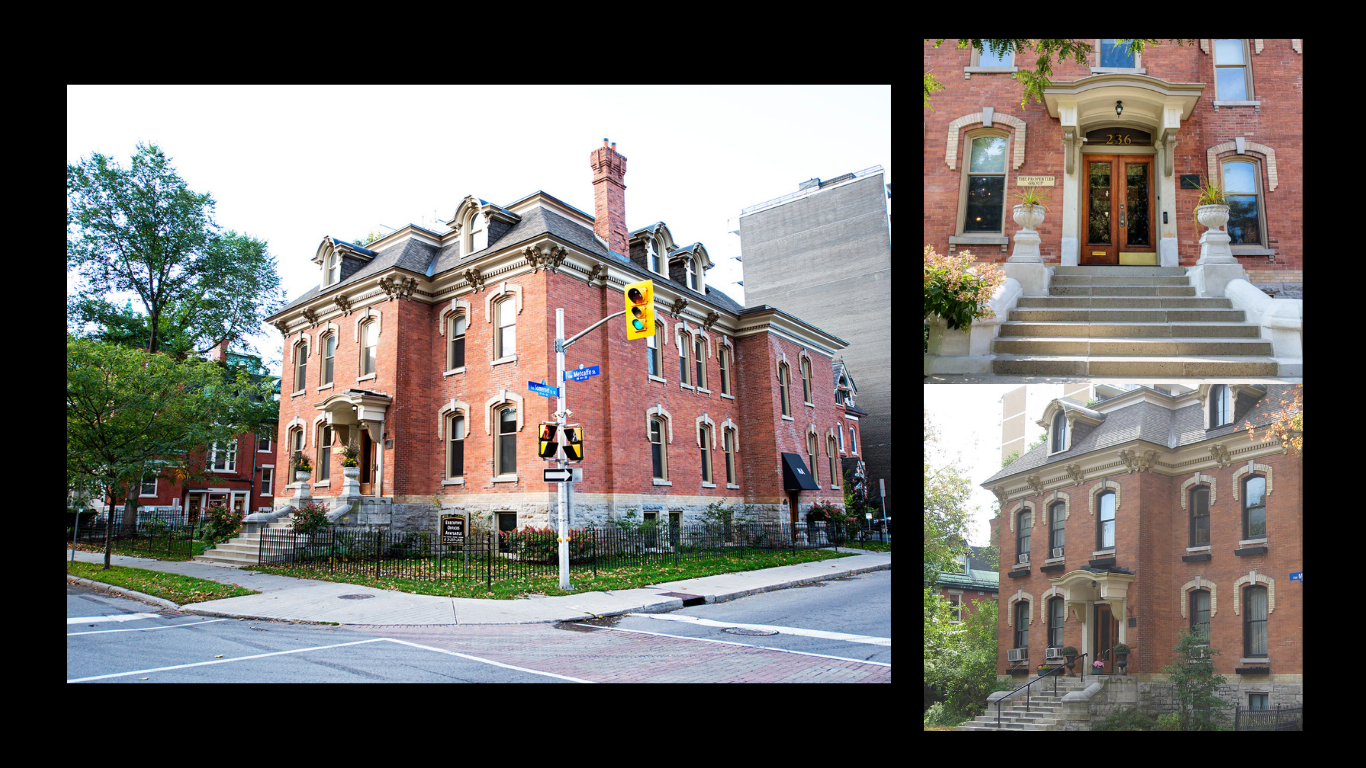
Located at 236 Metcalfe Street this elegant 2 1/2 storey red brick house was erected in 1884 and is an excellent example of the Second Empire style, whose most characteristic feature is the Mansard roof. Inspired by French architecture of the Second Empire period, other features of the style seen here include its handsome, classical composition of evenly spaced window and door openings and their elaborate surrounding trim. The design is attributed to William Hodgson, architect.
The house was designated under Part IV of the Ontario Heritage Act for its architectural excellence, significant historical associations, and the importance of its setting. It is a rare example of a designation in Ottawa that includes the interior, which is truly splendid.
As well as Sir Alexander Campbell (a Father of Confederation and once a law partner with Sir John A. Macdonald and later Lieutenant Governor of Ontario), the house was home to several prominent Canadian politicians. They included Sir John Carling of Carling Brewing and Malting fame, the Hon. William S. Fielding, and Sir Louis H. Davies, once a Premier of Prince Edward Island, and later the Chief Justice of the Supreme Court. All of these prominent former owners were at one time federal cabinet ministers, and it is appropriate that their fine home on Metcalfe Street leads to Parliament Hill.
In 1926, Lady Evelyn Byng, wife of the Governor General, re-opened the house as the Chelsea Club, a private club for socially prominent women. The Chelsea Club closed in 2009. The building is now owned by The Properties Group, a properties management company, and houses its offices.
As you walk past this building, take the time to read the two plaques erected by the Historic Sites and Monuments Board of Canada. One is to Sir Alexander Campbell, mentioned above, honoured here for his role as a Father of Confederation in the creation of Canada. The other plaque honours Colonel Elizabeth Smellie (1884-1968), the first woman to be promoted to that rank in the Canadian Army. A decorated military nurse in the First World War, she was made Matron-in-Chief of the Royal Canadian Medical Corps during the Second World War, among her many other remarkable achievements.
The house is part of a suite of splendid residences lining Metcalfe Street, and it is a prominent feature of the Centretown Heritage Conservation District.
Sources
Individually Designated Properties City of Ottawa
Ottawa: A Guide to Heritage Structures (Ottawa: City of Ottawa, 2000), pp. 81, 114-115.
Andrew Waldron, Exploring the Capital: An Architectural Guide to the Ottawa-Gatineau Region (Vancouver: Figure 1 Publishing 2017), p. 64.
Shannon Ricketts, Leslie Maitland and Jacqueline Hucker, A Guide to Canadian Architectural Styles, 2nd ed., (Peterborough: Broadview Press and University of Toronto, 2004), pp. 87-91.
Christina Cameron and Janet Wright, The Second Empire Style in Canadian Architecture (Ottawa: Parks Canada, 1980).
Smellie, Elizabeth National Historic Person, Parks Canada: https://www.pc.gc.ca/apps/dfhd/page_nhs_eng.aspx?id=12875
