21. Billings Estate
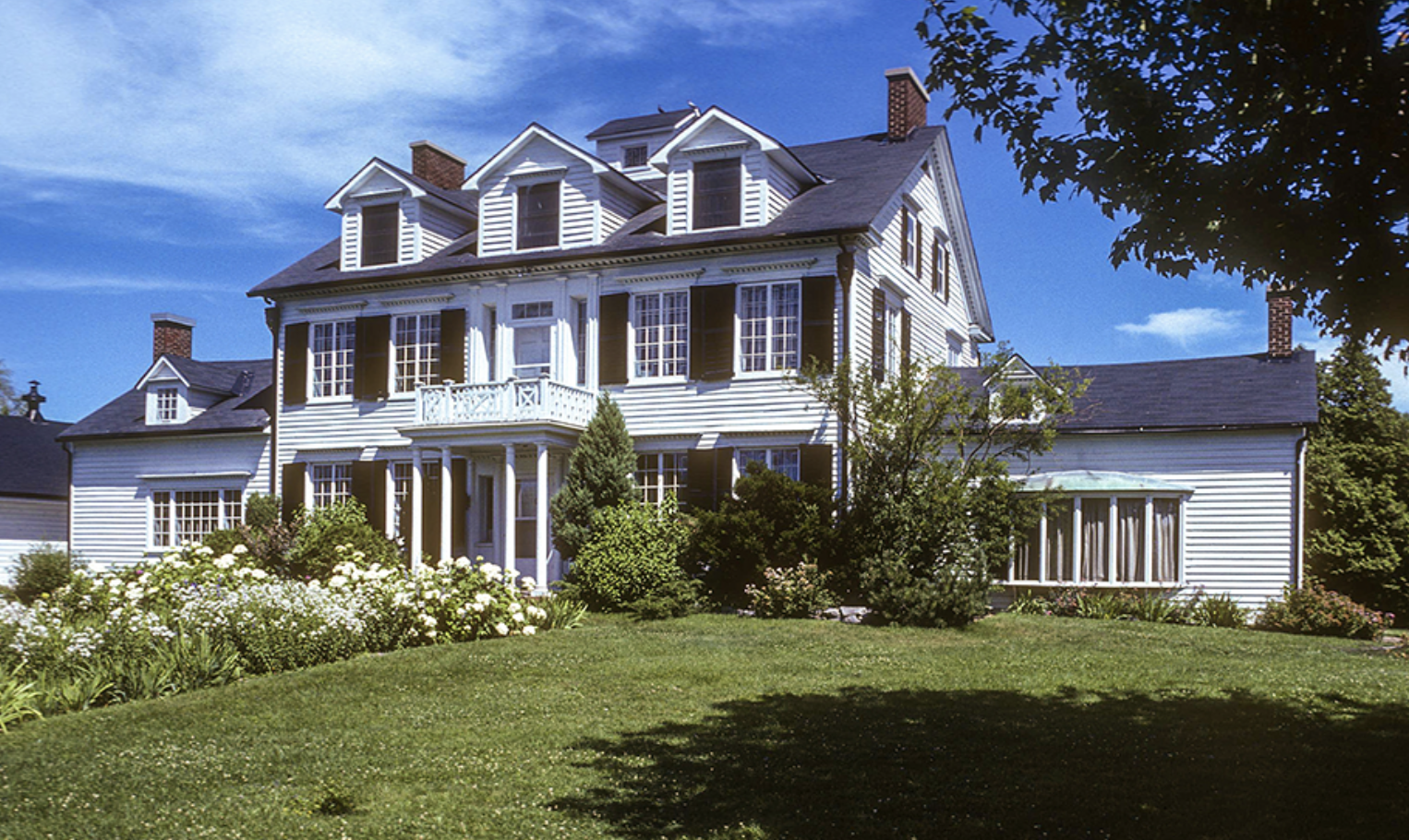
Idyllically situated on a forested hill overlooking the Rideau River, the Billings Estate, originally known as Park Hill, includes a gracious Georgian style house constructed in 1828-29 with matching front and rear façades, effectively transplanting a New England home to the Ontario wilderness. Additions and alterations over the years resulted in its current appearance as a central pavilion with wings.
Braddish Billings (1783-1864), Gloucester Township's first settler in 1812, was born in Massachusetts, but moved to the Brockville area with his Loyalist family when he was 9. An enthusiastic entrepreneur, he settled on the south side of the Rideau River near present day Bank Street with his wife Lamira Dow of Merrickville. A pioneer in local lumbering and agriculture, he also held several administrative offices including magistrate and Justice of the Peace. His home and farm formed the nucleus of the village of Billings Bridge.
Billings was part of the movement to make Bytown the judicial seat of its own district, and helped to construct its first jailhouse and courthouse, which qualified the town for this distinction.
After the death of Braddish Billings in 1864, Lamira continued to live in the house. The estate remained home to five generations of the Billings family.
In 1959, the family sold a section of the estate lands for the development of single family housing, which was followed by a failed attempt in1965 to rezone the estate lands, including the house, to allow for increased density.
Billings House was designated a National Historic Site of Canada in1968 in recognition of the timber-frame construction, wood cladding and classically inspired exterior detail including returned eaves, dentilled cornice and window headers.
A more serious threat soon emerged when in June of 1969, a development group optioned the property with the intention of demolishing the Billings House to build 20 single-family, luxury homes on the estate lands.
Historian Gladys Blair led the opposition to the proposed development. A member of the Heritage Committee of A Capital for Canadians (which later became Heritage Ottawa), Ms. Blair galvanized public support with numerous advocacy articles and interviews.
By 1970, with public pressure intensifying, the development group offered to donate the Billings House and three acres of land to the Ontario Heritage Foundation, conditional on obtaining zoning approval for new town houses and an apartment tower on the remaining 8.5 acres. After extensive negotiations, the City of Ottawa purchased both the Billings Estate House and grounds, taking possession on June 30, 1975 and formally designating the property under Part IV of the Ontario Heritage Act in 1978.
The City of Ottawa restored the building with the help of Parks Canada and the firm of Eriksson Padolsky and continues to own the Billings Estate, where it now operates the Billings Estate Museum featuring the historic house, multiple outbuildings, and a pioneer cemetery.
Heritage Ottawa counts helping to save the Billings House as one of its most important early advocacy efforts.
Sources
City of Ottawa Archives. The Billings Family Virtual Exhibit. n.d. https://documents.ottawa.ca/sites/default/files/billings%20family%20virtual%20exhibit_en.pdf
Heritage Ottawa. 50 Years | 50 Stories. https://heritageottawa.org/en/50years/3-billings-estate-house
Ottawa. Local Architectural Advisory Committee. Ottawa: A Guide to Heritage Structures. Ottawa. 2000.
Parks Canada. Directory of Federal Heritage Designations. Billings House National Historic Site of Canada.
Andrew Waldron. Exploring the Capital: An Architectural Guide to the Ottawa-Gatineau Region. Figure 1 Publishing, Vancouver. 2017.
