2. Colonel By’s Chaudière Bridge
Lt.-Col. John By of the Royal Engineers arrived in the area now known as Ottawa in 1826, tasked by the Crown with overseeing the construction of the Rideau Canal. The only connection from Wright's Town (later Hull) to Upper Canada was by ferry boat to Richmond Landing on Lebreton Flats or a wharf at the foot of what is today Bank Street.
Recognizing the need for the building materials, labour, and essential knowledge early American settler Philemon Wright’s community would contribute to his project, By set out to construct the first bridges to connect the islands across the Ottawa River at the Chaudière Falls or Great Kettle. The islands and falls had been a sacred site called Akikodjiwan (Pipe Bowl Falls) by the Algonquin Anishinaabe First Nation. Spiritual gatherings and ceremonies had taken place there for millennia. Akikodjiwan remains a sacred place to this day.
For Wright, the Falls also provided a source of water power and the location for the first timber slide, constructed on the Lower Canada (now Quebec) side.
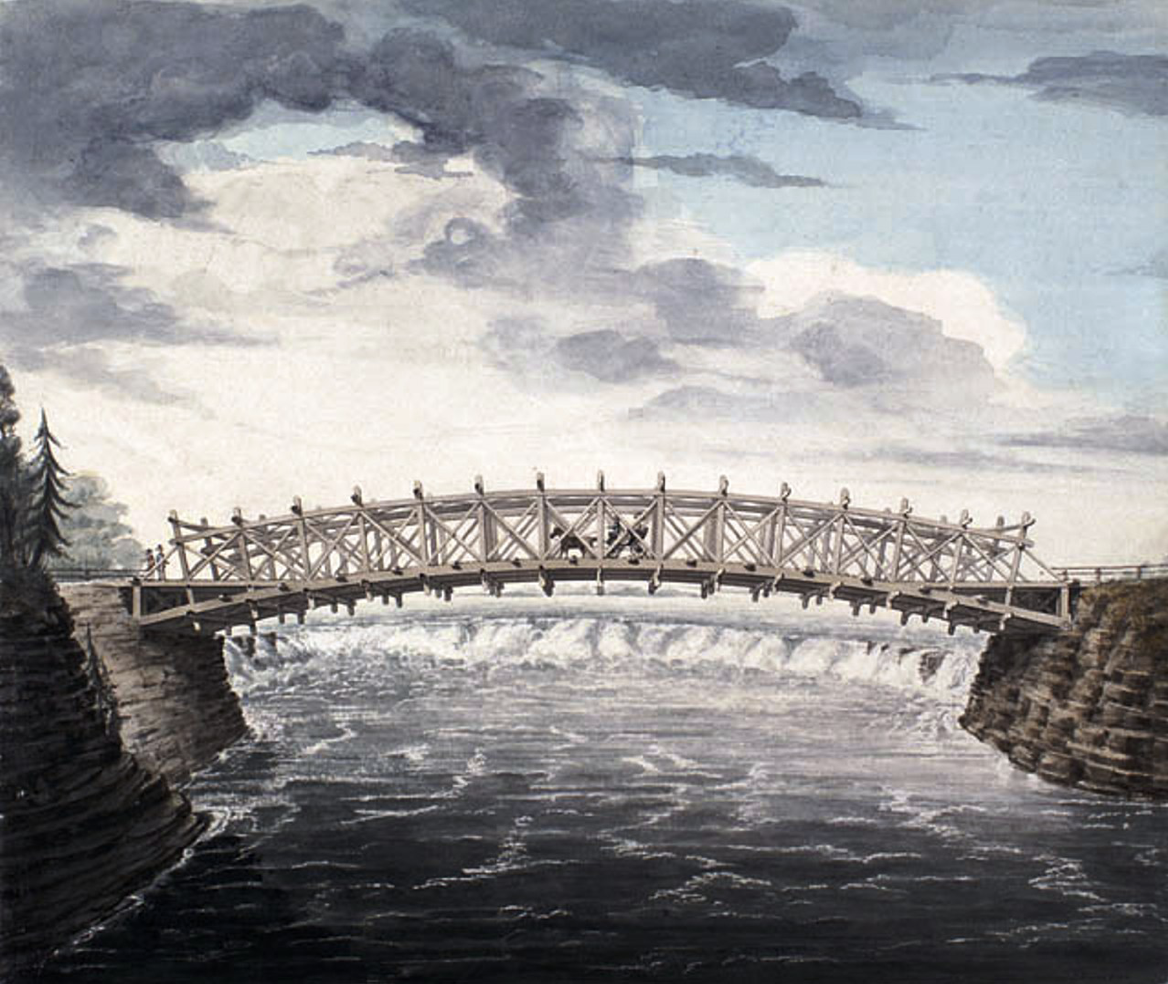
The most challenging of the bridges was at the 65-metre (212-ft.) wide channel below the Chaudière Falls. Starting in September 1826, a stone approach to the bridge was constructed from the north bank, with two arches, which are still there today. To cross the widest gap a rope was fired across with a cannon shot. Despite two failures during construction, a wooden arch truss bridge of unique design followed.
The summer of 1828 finally saw Lower and Upper Canada connected by the "Bytown Bridge". Simply constructed of timber trusses, supported by wrought iron chains with 10-inch links, it survived until 18 May 1836, three months after the death in England of Colonel By, when it collapsed into the river.
The bridge, as completed, is recorded in a watercolour by John Burrows, a civil engineer and overseer of works under Colonel By, who had previously settled in the area and became a town councillor in Bytown.
Colonel By had travelled in Europe to study engineering. He took the design concept for the bridge from a book by the famed Italian architect and engineer Andrea Palladio.
By 1843 a new stone and iron “Union Suspension Bridge,” was built to reconnect Bytown and Hull. It was followed by an iron truss bridge in 1889, which survived the great fire of 1900, though the other bridges between the islands were destroyed. The present steel arch truss bridge was constructed in 1919. Both the 1889 and the 1919 bridges were constructed without taking the previous bridge out of service.
Colonel By’s Bytown Bridge was essential to the early development of Bytown, providing a critical uninterrupted access across the Ottawa River during the construction of the Canal. Later replacement bridges continued to support the growing area.
For the Algonquin, Akikodjiwan remains a sacred place and efforts to legally challenge the rezoning of the area in 2015 for the Windmill development in favour of Elder Commanda’s Asinabka Plan were unsuccessful.
IMAGE: Bridges Erected Across the Ottawa River at the Chaudière Falls (Truss Bridge), watercolour, John Burrows, 1827 / Archives / Collections and Fonds Item ID number: 2833217
REFERENCES
Elder William Commanda, Asinabka, www.asinabka.com
Lynn Gehl, “Akikodjiwan: The Destruction of Canada’s Heart of Reconciliation,” Watershed Sentinel, March 8, 2018 https://watershedsentinel.ca/article/akikodjiwan/
James Powell, “The Chaudière Bridges,” HSO,
Robert F. Legget, “Colonel John By,” Dictionary of Canadian Biography, Vol. VII.
