16. Richmond Lodge – Armstrong House
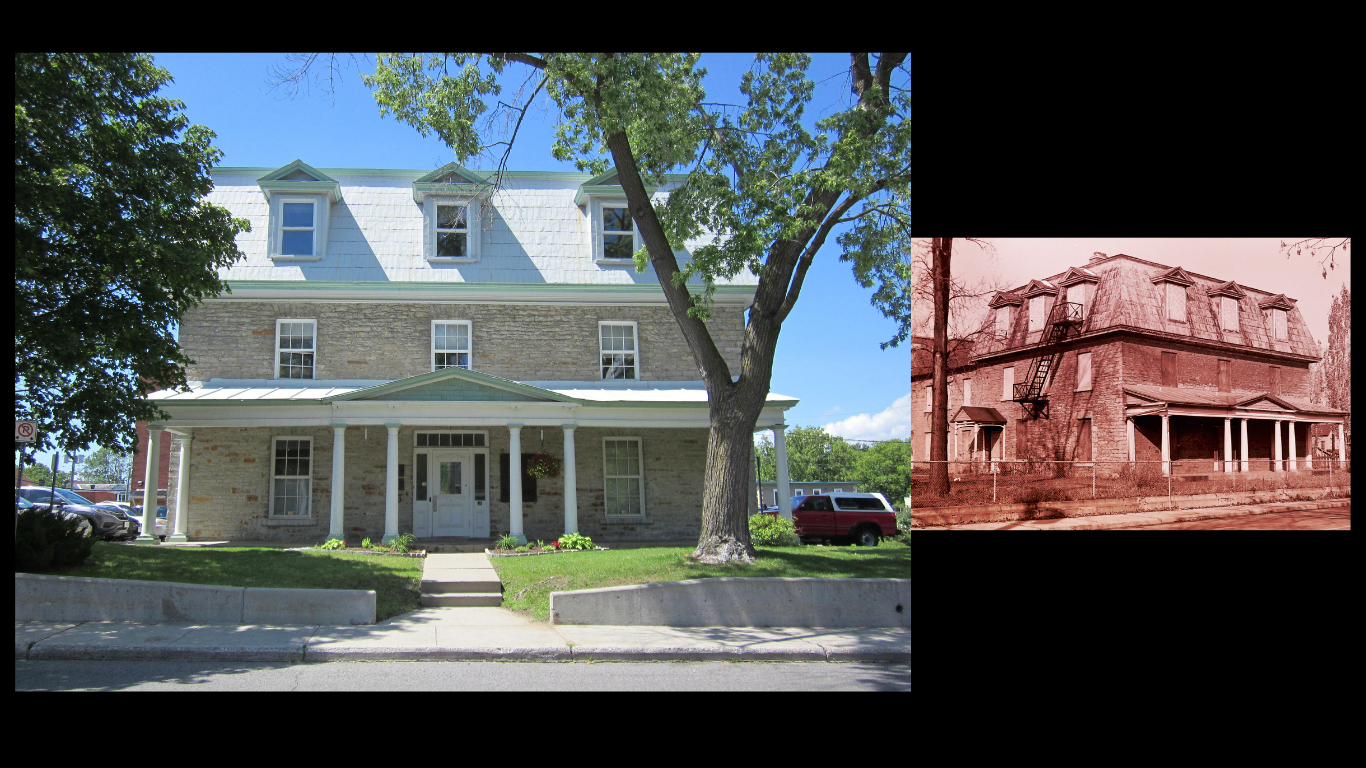
This handsome but simply designed Neoclassical house at 35 Armstrong Street in Hintonburg was the home of Carleton County’s first judge. It stands on a slight elevation and its once picturesque setting included a winding avenue of trees leading down to Richmond Road through a meadow and large garden. The house’s Neoclassical details include the importance of the entrance as expressed by the door case with rectangular transom, sidelights, and refined columned front porch.
Christopher Armstrong (1801-1874) was born and educated in Leitrim, Ireland, emigrating to Upper Canada in 1819. After law studies in Toronto and Belleville, he was called to the bar in 1834. In 1842, he was appointed Judge of the Bathurst District and shortly afterwards Judge of the District and Surrogate Courts of the new District of Dalhousie, which became the County of Carleton in 1850.
In 1854 Armstrong purchased 18 acres of land west of what is now Bayview Station Road from Nicholas Sparks, where he later built the large stone residence he named Richmond Lodge.
The 1861 Census of Upper Canada confirms that Judge Armstrong, his wife and four children were residents of Nepean Township living in a 2-storey stone house. The 1891 census specifies that the Armstrong house was a 16-room stone dwelling.
In addition to his legal duties, Armstrong served the community of Bytown as President of the St. Patrick’s Society of Ottawa, member of the board of the General Protestant Hospital and a patron of the Bytown Mechanics' Institute and Athenaeum.
The fulsome biography in Belden's Illustrated Historical Atlas of the County of Carleton noted that by his death "the Bench lost one of its brightest ornaments, the country one of its best citizens, and the people of Ottawa a friend whose place will not readily be filled, and whose memory will be ever fondly cherished."
The Armstrong family continued to live at Richmond Lodge until the death of Mary Anne, the judge's widow, in 1901. Much of the property had been subdivided into smaller lots in 1874 and 1885 .
In 1908 the property was acquired by the Soeurs grises de la Croix (see Byte #13), a teaching order, and a year later the Separate School Board built St. Conrad School on the north half of the property. St. Conrad's served as a girls primary school until it was closed in1963 and the sisters left the residence. For a brief period, the house was used for furniture storage by the Ottawa Separate School Board.
As a result of the Ottawa West Community Plan, the Armstrong House was designated by the City in 1976 "for architectural and historical interest ... one of a series of outstanding country estates to the west of the city along the historic Richmond Road."
The building remained a victim of demolition by neglect until it was purchased in 1984 by Eric Cohen, local entrepreneur and dealer in architectural antiques. Cohen received grants from the Ontario Heritage Foundation and the City to carry out required restoration work. The work was awarded an Architectural Conservation Award of Excellence from the City of Ottawa in 1988.
Richmond Lodge, now known as the Armstrong House, occupies half of the city block between Garland and Hilda streets, one block north of Wellington Street West. Heritage experts suggest that the heavy mansard roof was added when the house was sold to the Soeurs Grises (Grey Nuns also known as the Sisters of Charity of Ottawa).
Sources
H. Belden & Co. Illustrated Historical Atlas of the County of Carleton (including city of Ottawa) Ont. Toronto : H. Belden, 1879.
Ottawa: A Guide to Heritage Structure. Ottawa. Local Architectural Conservation Advisory Committee, 2000.
Sharon Trottier. “Saving our Heritage,” Ottawa Citizen, 12 March 1988 p. 57.
