32. Pattee / Freiman House
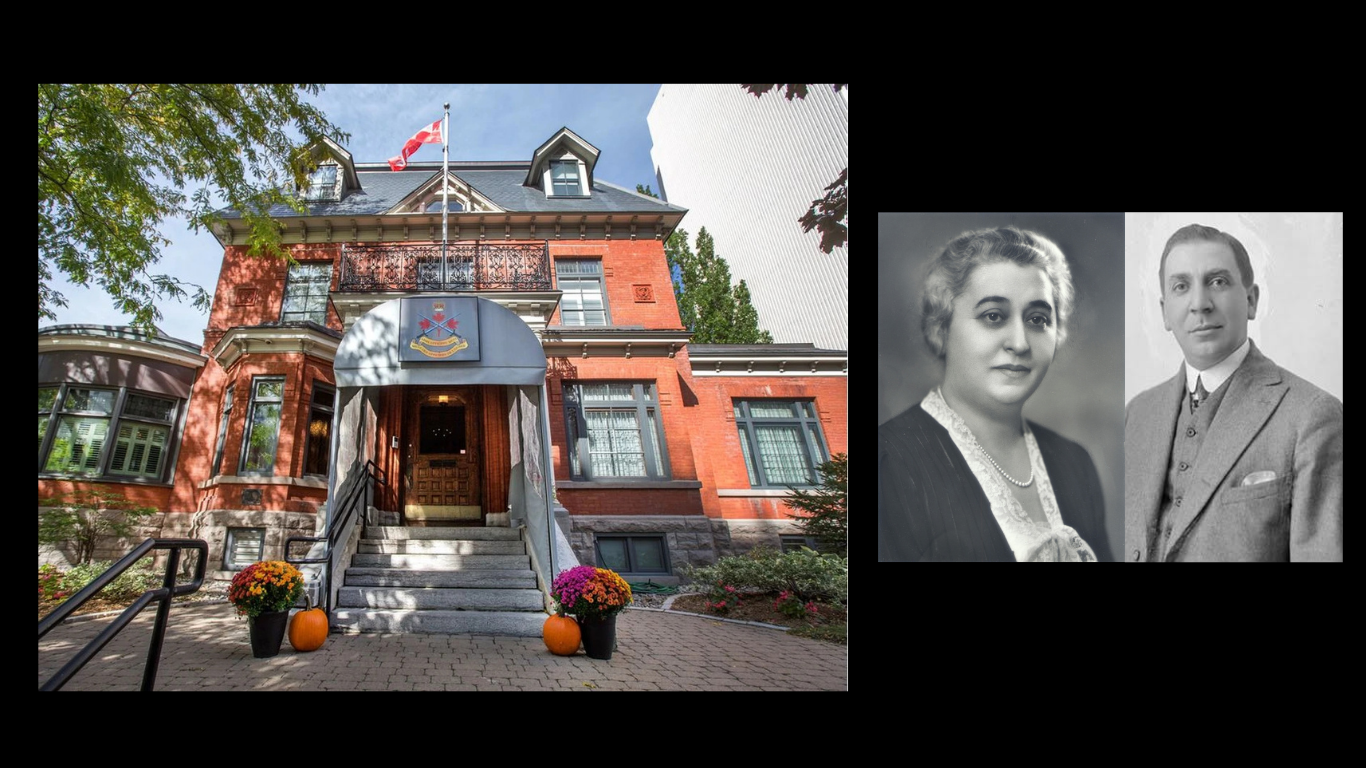
Built in 1891, this beautiful house at 149 Somerset Street West is a rare surviving example of late 19th century city mansion architecture in Centretown. It is significant for both its design and its association with three prominent figures in the early business, commercial, religious, and philanthropic communities of Ottawa. Today, this imposing residence is home to the National Capital Region Officers' Mess.
An elegant, two-storey, red brick structure set on a high base of rusticated stone, the house features a large, circular conservatory and a well-preserved fish-scale patterned slate roof punctuated by gabled dormers. The façade is enhanced by ornamental brickwork, notably the window surrounds and decorated chimney stack. Classical design touches include a series of terra cotta panels and Doric columns supporting the portico over the main entrance.
The house was home to three prominent Ottawans: Gordon B. Pattee (1824-1908), and Archibald J. Freiman (1880-1944) and Lillian Bilsky Freiman (1884-1940). American born Gordon Pattee, a prominent timber industrialist, arrived in Ottawa in 1855 where he resided until his death. From 1913, the house was home to prominent Canadian businessman and philanthropist Archibald Freiman, founder of Freiman’s, once Ottawa’s largest department store (taken over by The Bay in 1972), and his wife Lillian. The Freiman’s were important leaders in the Jewish Community. Archibald was a leading Canadian Zionist and a major philanthropist who supported both Jewish and non-Jewish charities. He offered his expertise to the federal government during both World Wars, as a member of the federal Victory Loan Committee and as a vice-president of the Associated War Relief Societies of Canada during WW1, and as a member of the National War Finance Committee in WW2.
The Freiman home was the birthplace of many charitable organizations spearheaded by Lillian Freiman, including a Jewish Red Cross Chapter (1915), the Great War Veteran’s Society (precursor to the Royal Canadian Legion) (1918), Hadassah-WIZO (1919), Canada’s Poppy Campaign (1921), and the Disraeli Chapter of the Imperial Order of the Daughters of the Empire (I.O.D.E.). The very first Canadian poppies sold to raise funds for WW1 Veterans were made in the Freiman home. Lillian also helped coordinate Ottawa’s campaign to fight the Spanish Influenza outbreak of 1919 and brought many war orphans to Canada, one of whom she adopted. Much of her work was aimed at helping immigrants and those less fortunate, both Jewish and Gentile.
Lillian Bilsky Freiman was the first Jewish Canadian to receive the Order of the British Empire (1934) and the first woman ever awarded a lifetime membership in the Great War Veteran’s Society. In 2008, the Canadian government designated Freiman a Person of National Significance for her philanthropic work. The plaque is located at her former residence, just to the right of the main entrance.
The Pattee Freiman house was designated by the City of Ottawa under Part IV of the Ontario Heritage Act.
Photos: 149 Somerset St W: Wayne Cuddington/Postmedia; A.J. Freiman c. 1914 and Lillian Bilsky Freiman c. 1920s, Alex Dworkin Canadian Jewish Archives/Paul Horsdal
Sources
Ottawa: A Guide to Heritage Structures. (Ottawa: City of Ottawa, 2000)
Lilian Bilsky Frieman (1885-1940), National Historic Person, Government of Canada. https://parks.canada.ca/culture/designation/personnage-person/lillian-bilsky-freiman
The Historical Society of Ottawa. "A.J. Freiman," https://www.historicalsocietyottawa.ca/publications/ottawa-stories/personalities-from-the-very-famous-to-the-lesser-known/a-j-freiman
Ottawa. Individual Designation. List of Individually designated Properties, https://ottawa.ca/en/planning-development-and-construction/heritage-conservation/heritage-propertiesO/individual-designation/list-individually-designated-properties
