27. Pooley’s Bridge
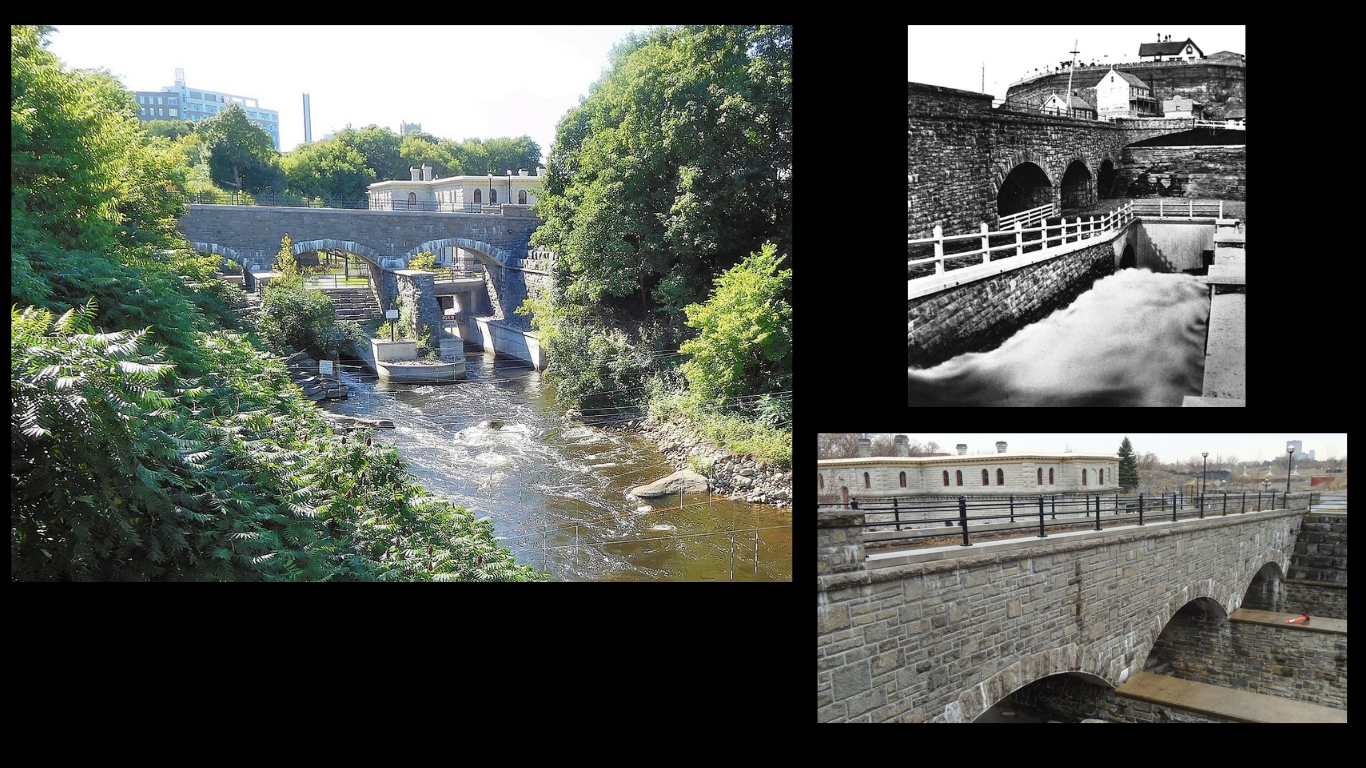
Tucked beneath the escarpment at the eastern edge of LeBreton Flats, the Ottawa Water Works Complex is made up of heritage structures — still in operation today — that tell the extraordinary story of intensive 19th-century industrial development in the LeBreton-Chaudière area. Pooley’s Bridge was a critical component of that complex, which also included the Fleet Street Pumping Station, a 750-metre long aqueduct, the channeled tailrace, and five stone bridges, of which Pooley’s is the only multi-span example.
Built in 1872 by local contractor Alexander Sparks, the bridge was designed by George Hugo Perry, city engineer for Ottawa. The large (37-metre-long) triple segmented stone-arched structure includes parapets, voussoirs and keystones, with a decorative metal railing. The elegant but solid masonry bridge rests on two abutments over the channeled tailrace, where water from the pumping station flows back into the Ottawa River.
Pooley’s Bridge is the oldest existing and still functioning structure from Ottawa’s municipal development program of the 1870s. A major public works initiative prompted by rapid growth in the young capital city and the devastating fire of 1870, the program established core civic infrastructure, most notably the Water Works Complex.
The name Pooley’s Bridge dates to the first round-log bridge on the site, constructed by Royal Engineer Lieutenant Henry Pooley in 1829. It was the final bridge needed to connect Bytown with the newly completed Union Bridge that spanned the Chaudière Falls to Wrightstown on the Lower Canada (Quebec) side of the river. It is written that Colonel By was so impressed with the structure built over “the gully” that he dubbed it “Pooley’s Bridge,” and the name stuck.
Pooley’s Bridge is unique in Ontario for being associated with a system of four single-span, stone-arch bridges that cross an open aqueduct and is a rare example of a large stone bridge in Ottawa that is representative of 19th century bridge design. It is linked to the historic water works complex, creating a picturesque cultural landscape comprised of the city’s last remaining 19th century structures on LeBreton Flats, a once bustling industrial area that, at its peak at the end of the 19th century, was the economic engine of the region.
Over the years, restoration work on the bridge has seen some of the masonry replaced, but the integrity of the original design remains intact.
In 1982, the City of Ottawa designated the pumping station and aqueduct under Part IV of the Ontario Heritage Act, and in 1995, Pooley’s Bridge and the channeled tailrace were similarly designated. In 2024, the two by-law designations were replaced with one comprehensive by-law to capture the site in its entirety and to identify specific heritage attributes and expand on the heritage significance of the Water Works Complex.
Pooley’s Bridge was closed to automobile traffic in 1983 and today the tailrace is used as a whitewater kayak course managed by the Ottawa River Runners.
SOURCES
City of Ottawa, “Update to the Designation of the Ottawa Water Works Complex under Part IV of the Ontario Heritage Act,” File number: ACS2024-PRE-RHU-0017, Report to the Built Heritage Committee, February 13, 2024.
City of Ottawa, Ottawa: A Guide to Heritage Structures. Local Architectural Conservation Advisory Committee, 2000.
