23. Parliament Hill (Part 1)
The Parliament Hill complex is arguably the most recognizable assemblage of buildings in Canada. Its soaring Peace Tower is a powerful national symbol.
Parliament Hill has been the seat of Canada’s national government since Parliament's first session opened on November 6, 1867. It has witnessed significant events, among them the burning of Centre Block in 1916; the official opening of the Peace Tower in 1927; the patriation of the Canadian Constitution in 1982; the turn of the new Millenium in 2000; countless Canada Day celebrations; and parades by the Ceremonial Guard since 1959.
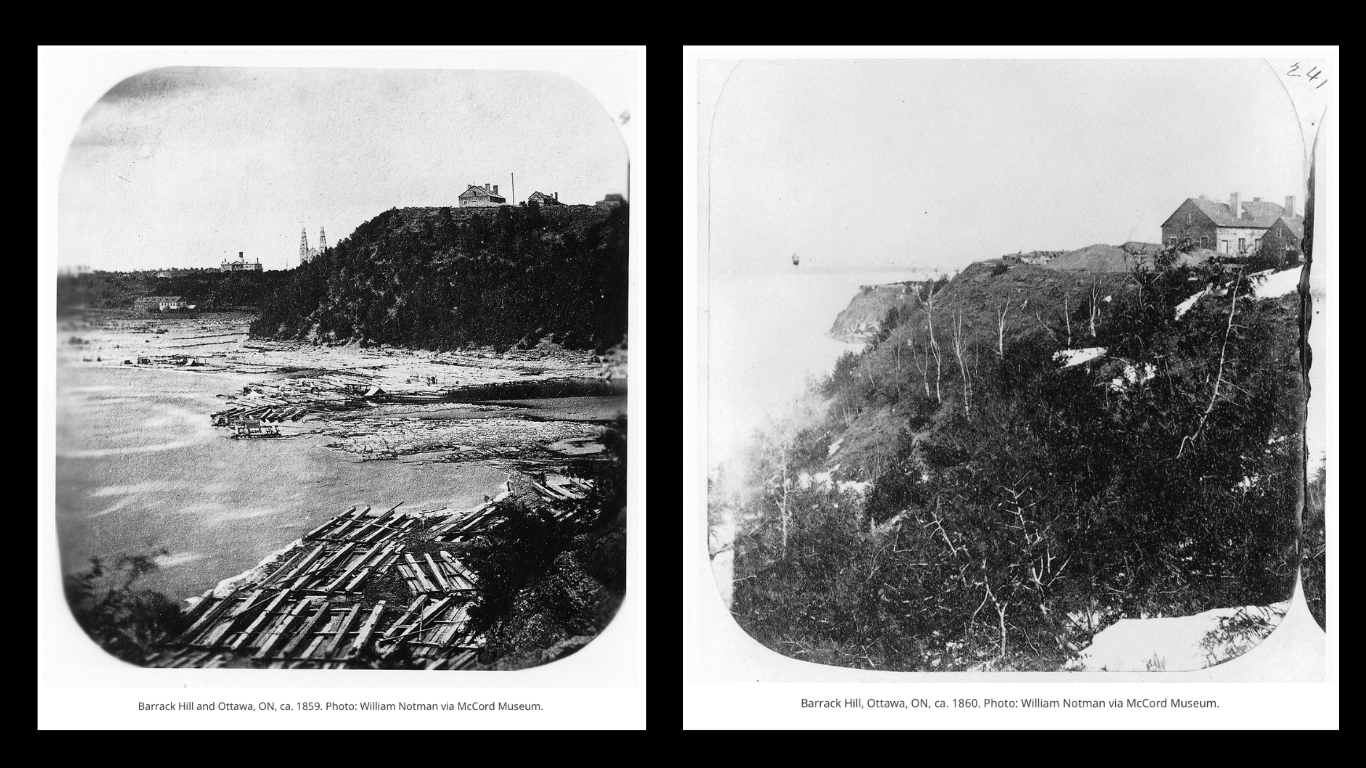
The Parliament Buildings stand on a promontory 50 metres (160 feet) above the Ottawa River. Until the early 19th century, this significant natural outcrop would have provided local indigenous communities with an excellent vantage point of the river and beyond.
In 1812, United Empire Loyalist Thomas Fraser bought the promontory and other land for “Twelve Pounds Nova Scotia currency.” His son Hugh then made a nice profit by selling the Hill to Lord Dalhousie in 1823 for 750 pounds. Lord Dalhousie, Governor General of British North America, considered its commanding site ideal for a fort to guard the entrance to the canal soon to be built between the Ottawa River and Kingston. When Colonel By started the Rideau Canal project in 1826, his sappers and miners lived on this land that became known as Barrack Hill.
The 1839 Durham Report and subsequent Act of Union of 1840 changed the Hill forever. They brought together Upper and Lower Canada as the Province of Canada, with its capital until 1865 variously in Kingston, Montreal, Toronto, and Quebec City. The small and rough lumber town of Bytown was never in the mix. However, in 1857 Queen Victoria declared Ottawa would serve as the permanent capital of the Province of Canada. The Governor General at the time, Sir Edmund Walker Head, had written to the Queen that ‘Ottawa is the only place which will be accepted by the majority of Upper and Lower Canada as a fair compromise.’ A cunning political decision.
The new capital needed space for parliamentarians and civil servants. Barrack Hill was the obvious site upon which to erect such facilities for the Province. The Commission of Public Works advertised in 1859 for plans for public buildings - a parliament building to be flanked by two departmental buildings. The structures were proposed “to be built in a plain, substantial style of architecture, of coarse hammer-dressed masonry…”
What happened next? Watch for Part 2.
Sources
Kalman, Harold, A History of Canadian Architecture, vol 2, Oxford University Press, Toronto, Ontario, 1994.
Phillips, R. A. J., The East Block of the Parliament Buildings of Canada, Roger Duhamel, Queen’s Printer and Controller of Stationary, Ottawa, 1967.
Waldron, Andrew, Exploring the Capital: An Architectural Guide to the Ottawa-Gatineau Region, Figure1 Publishing Inc., Vancouver, British Columbia, 2017.
Wright, Janet, Crown Assets; The Architecture of the Department of Public Works, 1867-1967, University of Toronto Press, Toronto, Ontario, 1997.
Heritage Ottawa, 50 Years, 50 Stories: https://heritageottawa.org/en/50years/2-east-block-parliament-hill
Boswell, Randy, “Time to acknowledge evidence: Parliament Hill sits on Indigenous territory” iPolitics, November 9, 2018: https://www.ipolitics.ca/2018/11/09/time-to-acknowledge-evidence-parliament-hill-sits-on-indigenous-territory/
Government of Canada: History of Parliament Hill: https://www.canada.ca/en/public-services-procurement/services/infrastructure-buildings/parliamentary-precinct/history.html
