18. Aylen-Heney House
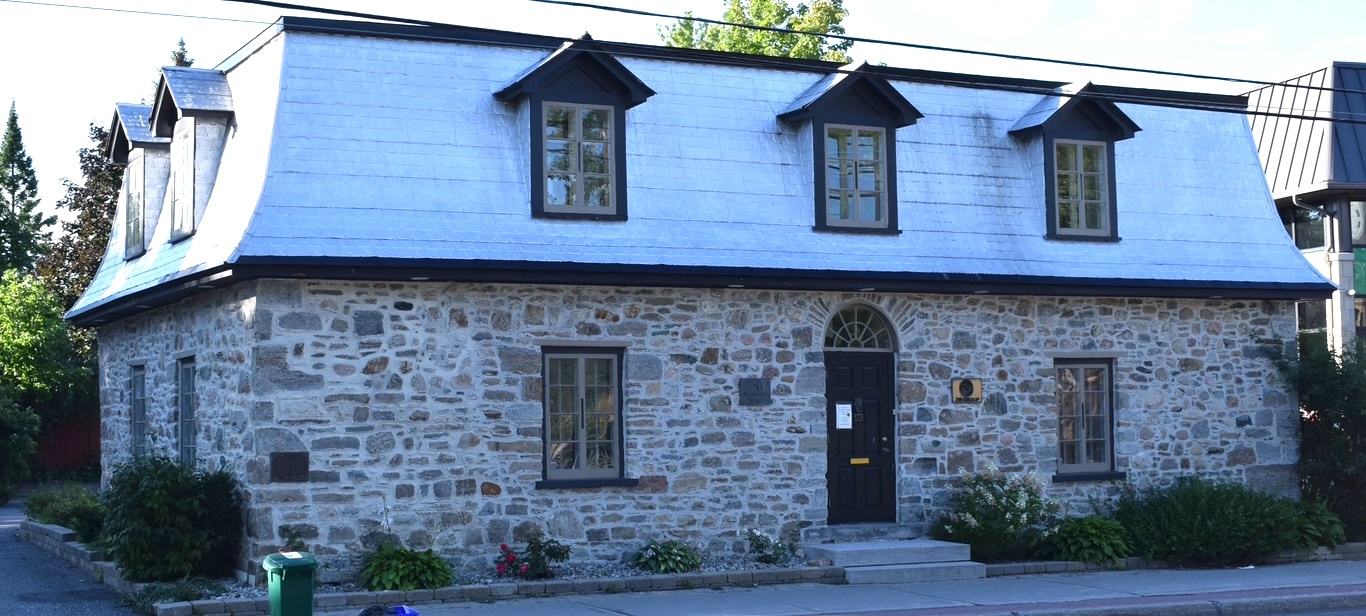
The stone cottage at 150 Richmond Road is a link to the colourful world of Bytown’s lumber industry in the early 19th century. Peter Aylen (1799-1868), "a man of insatiable ambition" according to his biographer Michael Cross, was a successful timber producer and later public official who held cutting rights along the Gatineau and Madawaska rivers in the 1830s and 1840s.
For a time, Aylen was known as the “King of the Shiners,” leading Irish Catholic labourers in a campaign of violence in Lowertown against French-Canadians, led by Joseph Montferrand, who were competing for work in the lumber camps. Known as the 'Shiners' Wars,’ the open violence only came to an end with the creation of the Ottawa Lumber Association.
Aylen purchased land on Richmond Road near present day Kirkwood Avenue in 1821 and 1825. He established a 150-acre farm containing a two-storey house, barns, and other outbuildings, as advertised for lease in the Bytown Gazette in 1836. Aylen moved to a farm in Lower Canada on the north side of the Ottawa River in 1837, following several years of promoting violence in Bytown affairs.
John 'Buffalo' Heney (1814-1896) purchased the property in 1854 where his family remained for nearly 100 years. ‘Buffalo’ Heney was so named to distinguish him from the more prominent John Heney, a Lowertown businessman, politician and temperance campaigner. He was successful in the leather manufacturing business and in real estate in Upper Town, and he represented Wellington Ward on city council for six years.
Heney’s son, Frederick, continued to live in the house with his wife. They called it "Syringa Cottage” according to the birth announcements that appeared in the newspapers in the 1890s. In 1900, the family moved across the street to a 33-room mansion that they designed and built. It was referred to as “Carleton Lodge” in birth notices and in newspaper reports of the lavish social events the Heneys hosted there. The mansion was demolished in 1947 to make way for the construction of the Canadian Bank Note Company, which remains on the site today.
Ottawa entrepreneur Eric Cohen purchased 150 Richmond Road from the Heney’s in 1988. It was his research of the property's history that led to its designation under the Ontario Heritage Act that same year. The designation by-law includes this description:
"The symmetrical design and unusual proportions exhibit a layering of architectural changes reflected by a vernacular blend of English Georgian stylistic features with traditional French Canadian building elements. Of particular note are the large rough-cut stone coins, half-round fanlight over the centre entrance, casement windows and metal-clad mansard roof with flared or bell-cast eaves. These architectural features, combined with the building’s close proximity to the street, create a minor landmark along this section of Richmond Road."
Cohen carried out a major restoration of the house, converting it from a rough, derelict residential duplex to an impressive updated heritage commercial property, now the offices of ZW Group.
The next time you’re travelling or walking along that stretch of Richmond Road, take moment to stop and admire this impressive little stone house.
Sources
Ottawa Historical Society. The Shiners' War.
Michael S. Cross, “Aylen (Vallely), Peter,” in Dictionary of Canadian Biography, vol. 9, University of Toronto/Université Laval, 2003– https://www.biographi.ca/en/bio/aylen_peter_9E.html, accessed May 17, 2026.
Dave Allston. “Early Days: Richmond Road’s Home With a Forgotten Name,” Kitchissippi Times, August 18, 2016.
Dave Allston. “Hidden History of Kitchissippi's Own Pioneer House,” Kitchissippi Times, February 4, 2019.
