17. McKellar-Bingham House
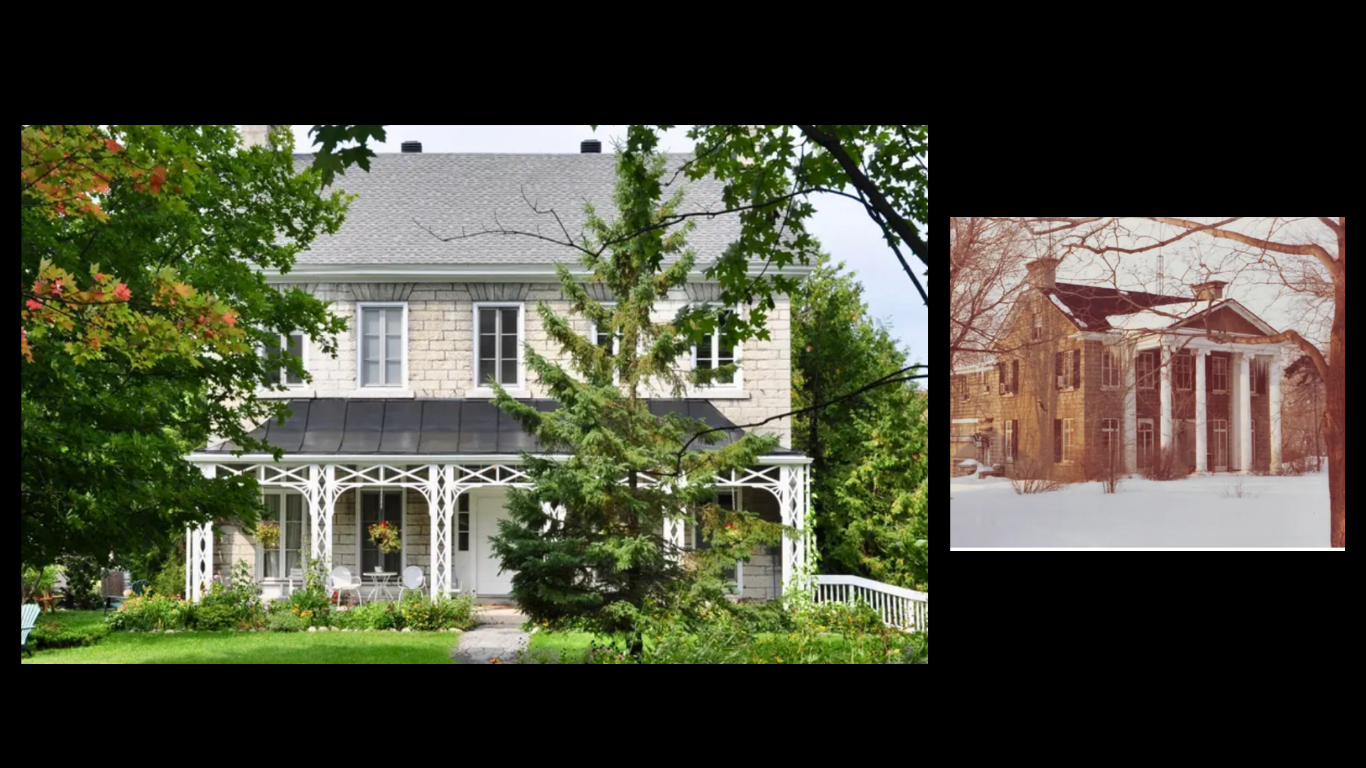
The history of this elegant house at 635 Richmond Road bears witness to the era of westward agricultural expansion along the Ottawa River in the early 19th century. As farmers prospered, their early log houses were replaced by substantial stone structures, starting with Maplelawn in the 1830s (see Bytes #14 and #15) built by the Thompson family. John Thompson went on to build the McKeller Bingham House just to the west in the 1840s, which also replaced an earlier log farmstead.
The McKellar Bingham House is named for later owners: Dairy farmer Archibald McKellar acquired the house and its surrounding property in the 1870s; and John Bingham, a director of the Ottawa Dairy Company, bought the house in 1910 (McKellar sold the bulk of the farm separately to a consortium called McKellar Townsite Co.)
The house is a fine example of British classicism then in vogue in the Canadas: symmetrical façades, evenly spaced windows and centre door, all executed in superior masonry likely by the same craftsmen who built Maplelawn. The original delicate, Regency-style verandah was replaced by Bingham in the early 20th century with a bolder design, supported by heavy columns and a pediment. Wooden fencing was replaced by a stone wall topped with iron grillwork, still visible today.
After Mr. Bingham’s ownership the house fell upon precarious times. In 1953, it was purchased by radio station CKOY resulting in the removal of many interior finishes. The station broadcast from the house until 1978, when it was designated heritage by the City, who acquired it in 1980. Determined to ensure its use as a residence, the City negotiated with a property developer to retain it for inclusion in a townhouse development. The City also returned the verandah to a design closer to the original, which is what we see today.
The construction of the surrounding townhouse development gave the McKellar Bingham House a new lease on life, while at the same time changing its historical setting forever. As a farmstead, pastures stretched out from either side of the house with a broad lawn leading down to the river. As the city developed, access to the river was first cut by the Ottawa to Pembroke rail line, then by the NCC’s Ottawa River Parkway (now called the Kitchissippi Mikan), then by the surrounding townhouse development.
The formula of surrounding an historic structure with infill development has its merits in many circumstances, as can be seen next door at 653 Richmond Road, a 1920-era Tudor Revival house built by John Bingham for his daughter. Its once-extensive grounds are occupied by a townhouse development.
Sources
Andrew Waldron, Exploring the Capital: An Architectural Guide to the Ottawa-Gatineau Region (Vancouver: Figure 1 Publishing, 2017), p. 208;
Harold Kalman and John Roaf, Exploring Ottawa (Toronto: University of Toronto Press, 1983), p. 153;
Dave Allston, “McKellar-Bingham House has a Unique History of its Very Own,” Kitchissippi Times, September 28, 2018;
Leslie Maitland and Louis Taylor, Historical Sketches of Ottawa (Peterborough: Broadview Press, 1990), pp. 132-34;
Leslie Maitland, Neoclassical Architecture in Canada (Ottawa: Parks Canada, 1984);
Shannon Ricketts, Leslie Maitland, Jacqueline Hucker, A Guide to Canadian Architectural Styles (Peterborough: Broadview Press, 1984);
www.ottawa.ca/en/planning-development-and-construction/heritage-conservation/heritage-properties/individual-designation/list-individually-designated-properties.
