14. Maplelawn House
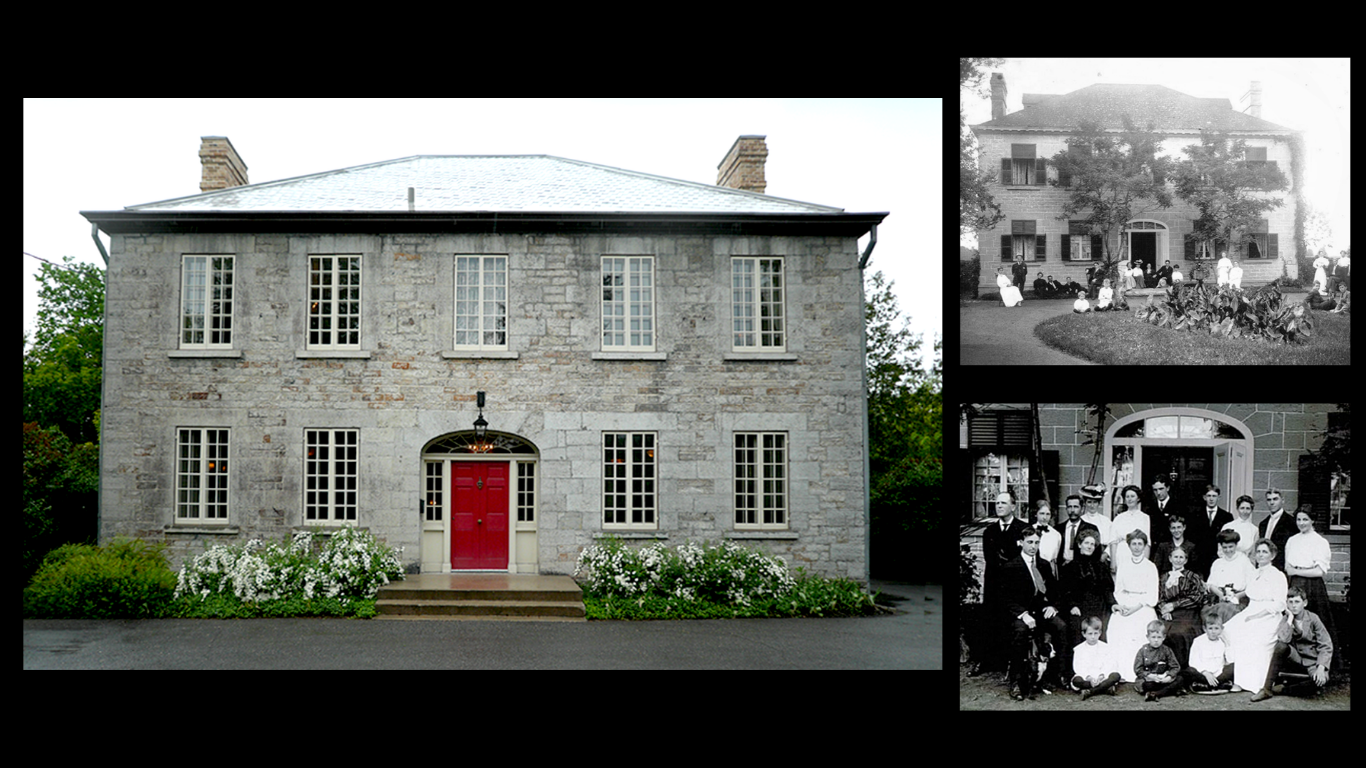
This elegant residence was the centrepiece of an early 19th-century country estate in Bytown. Today it stands on generous grounds that include a rare walled garden and forms part of the mixed residential and commercial neighbourhood of the Westboro area of Ottawa. Located at 529 Richmond Road, Maplelawn was designated a National Historic Site in 1989.
The 2 ½-storey stone house was built between 1831 and 1834 in the British 18th century classical tradition, evidenced in its strict adherence to symmetry and regularity as well as the absence of applied decoration. The symmetrical five-bay front façade of fine ashlar limestone is surmounted by a hipped roof flanked by two end chimneys. It has a centrally-placed main door surrounded by sidelights and a semi-elliptical fanlight. The building’s regularly-spaced multi-paned casement windows are not typical of the British classical style but rather reflect the influence of French Canadian craftsmanship on the domestic architecture of the Ottawa Valley at the time.
The austere façade gives way to a refined elegant interior which continues the symmetrical disposition of the exterior and its British classical tradition. With a centre-hall plan, the interior features a wide entrance hall with a Neoclassical semi-elliptical arch at its midpoint, a prominent spiral staircase, fireplaces, and original trim and decorative plasterwork. Its fine craftsmanship reflects the high quality of carpentry and joinery then available in the area.
The house, built for William Thomson, a Scottish immigrant and prosperous farmer, is a visual reminder of the early economic history of the Ottawa Valley as an agricultural community. This substantial family residence, which once occupied 200 acres of land, was part of an early farming estate in the Ottawa-Hull region that quickly became one of the most prosperous in the area.
Maplelawn is associated with three important local families. It was first the Thomson’s home before being sold in 1877 to Thomas Cole, successful lumberman and dairy farmer, who renamed the property Highland Park Dairy Farm. In 1895 Thomas sold the farm to his son, John, under whose leadership the dairy in 1899 became the first in Canada to have electricity. In 1935, the property was purchased by Lloyd B. Rochester whose mother was a Cole. Rochester hired Ottawa architect Gordon Hughes to make changes to Maplelawn, including the addition of a summer kitchen. In 1952, the Federal District Commission (precursor to the National Capital Commission) purchased the property to ensure its preservation.
Maplelawn is one of the few surviving estate houses that once lined Richmond Road. The house has been leased to the Keg Steakhouse + Bar – Ottawa Manor since 1999. Its spectacular walled garden remains a much loved oasis in the city. The garden has been lovingly tended by the Friends of Maplelawn Garden since 1993. Watch for more about the garden in a future Byte.
In 1994, the City of Ottawa designated Maplelawn and Garden under Part IV of the Ontario Heritage Act, comprising one of the few historical landscapes designated in Ottawa.
Photos: Maplelawn, 2017: D.Jones; Members of the Cole and Rochester families at Maplelawn, 1907: City of Ottawa Archives CA-18672
SOURCES
https://www.pc.gc.ca/apps/dfhd/page_nhs_eng.aspx?id=465
https://www.pc.gc.ca/apps/dfhd/page_fhbro_eng.aspx?id=2356
https://heritageottawa.org/en/50years/14-maplelawn-house-and-garden
Historic Places.ca
The John Rochester Family in Canada, revised edition, 1976, collected and compiled by Lloyd B. Rochester, Ottawa, ON.
