1. In the Beginning…
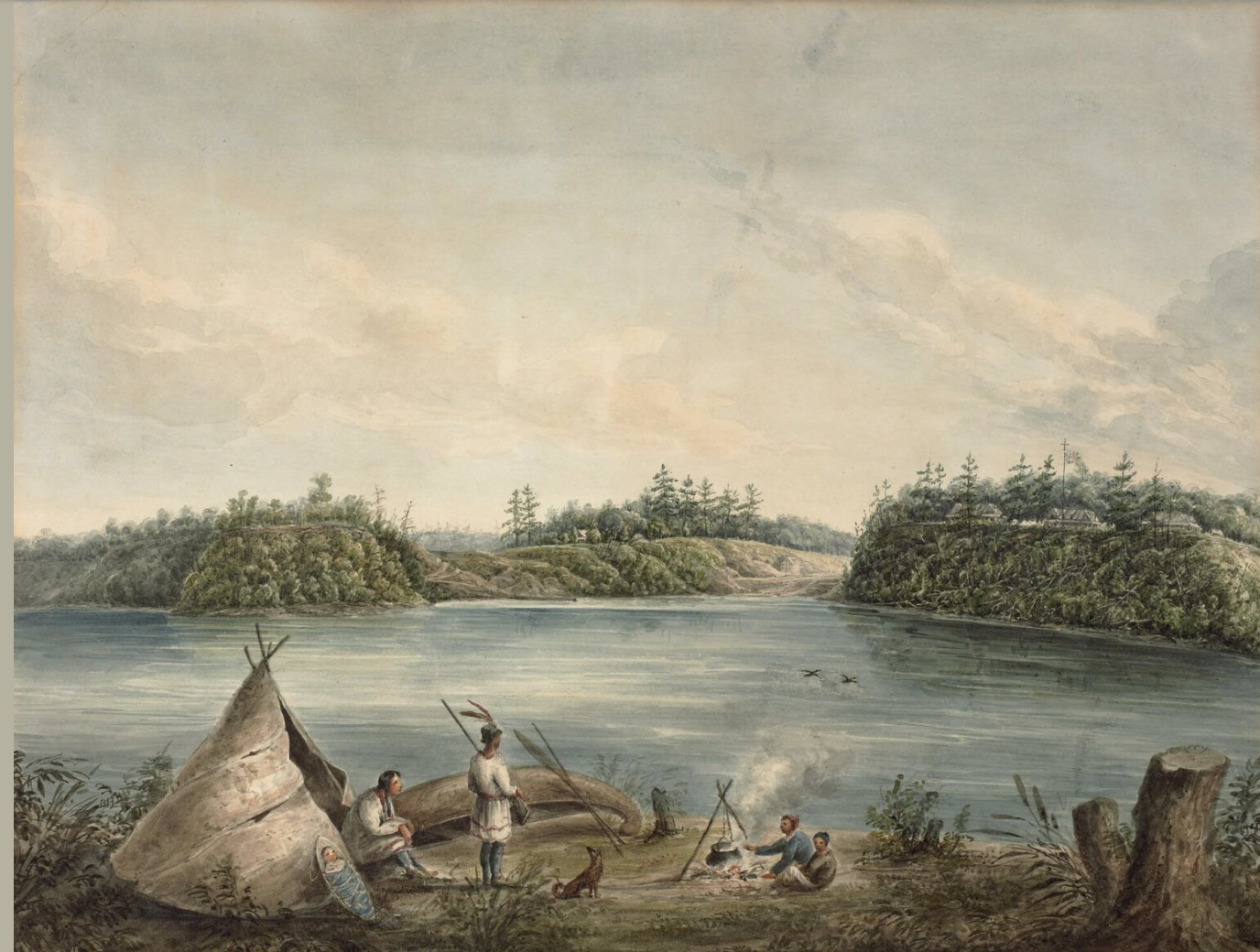
The story of Bytown begins with its interconnecting waterways and natural gathering places along the well-travelled trading routes used by Indigenous peoples for millennia.
Long before settlement, the Anishinaabeg people of the Ottawa Valley and beyond had divided the land into established family hunting and fishing grounds. Grand Chief Pierre-Louis Constant Pinesi (1768-1834) was an important Algonquin chief in the Ottawa area whose family’s hunting grounds were on the south side of the Ottawa River at the Rideau River (now Centretown and Dalhousie) and abutting on the Chaudière Falls (Akikodjiwan).
The arrival of Col. John By and the Royal Engineers and the start of construction of the Rideau Canal in 1826, proved devastating for Chief Pinesi and his family’s traditional hunting grounds. The influx of thousands of workers brought timber cutting, land clearing, depleted game resources, and dam construction that flooded shorelines and disrupted fishing grounds. Flooding and log slides also destroyed sites of cultural importance, such as burial places and traditional meeting sites.
Chief Pinesi, who had fought for the British in the War of 1812 with four of his sons, was unable to secure his hunting and fishing lands despite submitting numerous government petitions throughout the 1820s until his death in 1834. Meanwhile, French, Scottish and English war veterans were being granted acreages in the area for settlement — people like Louis-Théodore Besserer, François Dupuis and Archibald Petrie.
Although Chief Pinesi’s petitions indicate that Crown representatives had given verbal confirmation of his rights to ancestral lands and compensation for settler encroachment, he sought legal recognition for specific land rights and compensation, and measures put in place to prevent further settlement. While sympathetic, British government officials never acted on any of the petitions in a meaningful way.
Impoverished, Chief Pinesi and his family, along with other Anishinaabeg, were forced to retreat beyond their ancestral lands to find subsistence. He and his wife died on August 13, 1834 during a cholera epidemic and are buried in the cemetery of L’Église de l’Annonciation-de-la-Bienheureuse-Vierge-Marie in Oka, Quebec.
Descendants of Chief Pinesi live around the region today with many in Pikwakanagan First Nation west of Ottawa and they continue to pursue a land claim.
Image: Entrance to the Rideau Canal, Ottawa River, Canada, watercolour by Henry Pooley in 1833 (National Gallery of Canada). A traditional Indigenous camping site with Col. By’s military barracks visible on what is today Parliament Hill and Col. By’s house on the left (demolished).
References
Albert Dumont, “The Kettle of Boiling Waters: Chaudière Falls, Algonquin Territory,” 2013 http://albertdumont.com/the-kettle-of-boiling-waters-chaudiere-falls-algonquin-territory/
Jack Hanna, “Ottawa 200: Chief Pinesi and the founding of Bytown,” CentretownBUZZ, 2026.
Noreen Kruzich, The Ancestors are Arranging Things - a journey on the Algonkin Trail. Ottawa: Borealis Press, 2011.
Jim Stone, a non-Indigenous historian who researched Chief Pinesi in consultation with members of the Algonquins of Pikwakanagan First Nation: “Grand Chief Constant Pinesi — Fighting a losing battle in a turbulent era,” https://kichisibiancienttrails.ca/grand-chief-constant-pinesi/
