6. Sappers’ Bridge
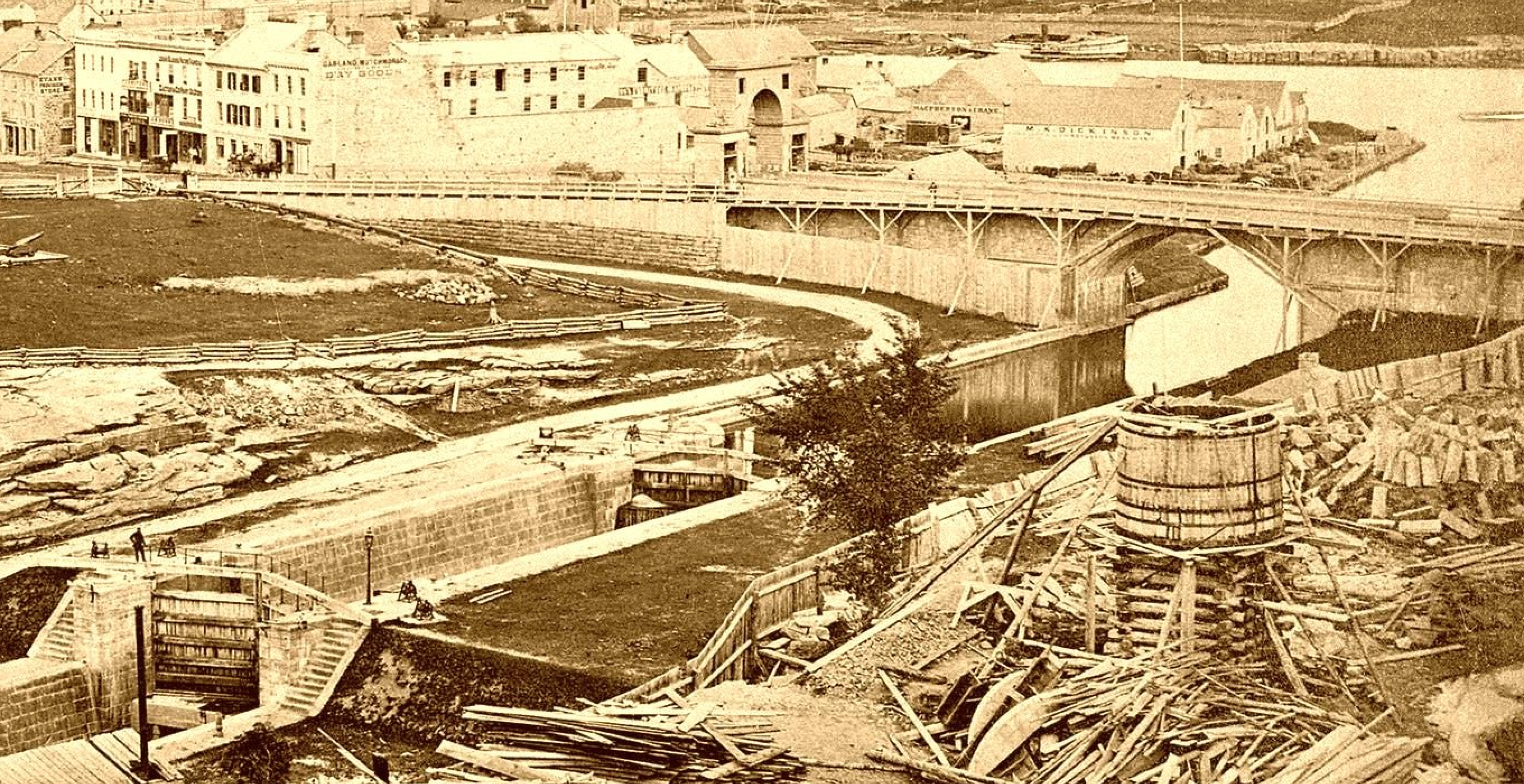
Built in 1827 by the Royal Sappers and Miners, a construction corps established in 1812 under the British Board of Ordnance, Sappers’ Bridge was the first and for many decades the only bridge to span the Rideau Canal to connect Lower and Upper Bytown.
An early task for the two companies of Sappers, each 81 strong, who came to Upper Canada in 1826, was to construct a stone arch bridge to link the three military barrack blocks and hospital, located on present-day Parliament Hill, to Lower Bytown, made up of large French and Irish Catholic working class communities. The western end joined a rough trail (later developed into Sparks Street) that lead towards Wellington Street and Upper Town, which was settled mainly by officers and wealthier English and Scottish Protestants.
The stone retaining walls and an embankment rising from Rideau and Sussex, site of the engineers' works yard, created a new landscape, which survives today.
Other works by the Sappers along the canal included important defensive blockhouses at Merrickville, Jones Falls and Kingston Mills.
The original Sappers’ Bridge was very narrow and by 1860 decks were added on each side of the bridge to create sidewalks, held in place by wooden scaffolding. These were later rebuilt with ironwork.
Sappers’ Bridge saw a number of other improvements over the years: gas street lighting by the mid-1850s; tracks for the horse-drawn cars of the Ottawa Street Railway after 1870; electric streetlights installed by 1885; and from 1892 streetcar tracks for the Ottawa Electric Railway.
For 85 years Sappers’ Bridge was the principal route from Lowertown and Rideau Street to Sparks Street. Construction of the adjacent Dufferin Bridge, completed in 1874, connected Rideau Street directly to Wellington Street, forming a triangle with Sappers’ Bridge.
The two bridges served Ottawa until 1912, when both were demolished and replaced with the concrete Plaza Bridge.
Sappers’ Bridge was the scene of the aftermath of the infamous Stony Monday riot in 1849 between Tories (Conservatives) and Reformers, when troops from Barracks Hill were able to keep the warring parties apart at the bridge.
Demolition of Sappers’ Bridge in 1912 proved difficult. Its great stone arch was so strongly built that it was almost impossible to break apart. Eventually, large stones dropped on the arch from a great height caused it to collapse into the canal. The demolition contractor, Mr. O’Toole, reported that “the bridge was one of the best pieces of masonry” he had ever taken apart. Two of the largest stones from the bridge were saved as a monument to Colonel By in Major's Hill Park in 1915. A bronze plaque said that the stones were from Sappers’ Bridge and marked the site of Colonel By's House. The monument was still there in 1955 but now is long gone.
It was easier to cut a hole through the retaining walls and embankment when the railway and streetcar tracks arrived from Hull in 1901. A small arch was also cut through the west side abutment so the Canal Road could reach the Commissariat.
When the Plaza Bridge was built in 1912, some of its stone foundations remained under the wide west arch. They are now exposed to view and a bronze plaque records the existence of the old bridge. The next time you are underneath Rideau Street’s Plaza Bridge, look closely at what appears to be a pile of discarded masonry. The stones are important relics of Ottawa’s history.
Photo: Sappers’ Bridge 1860, Samuel McLaughlin, LAC 3229737 (detail)
