3. The Ordnance and Engineers Building
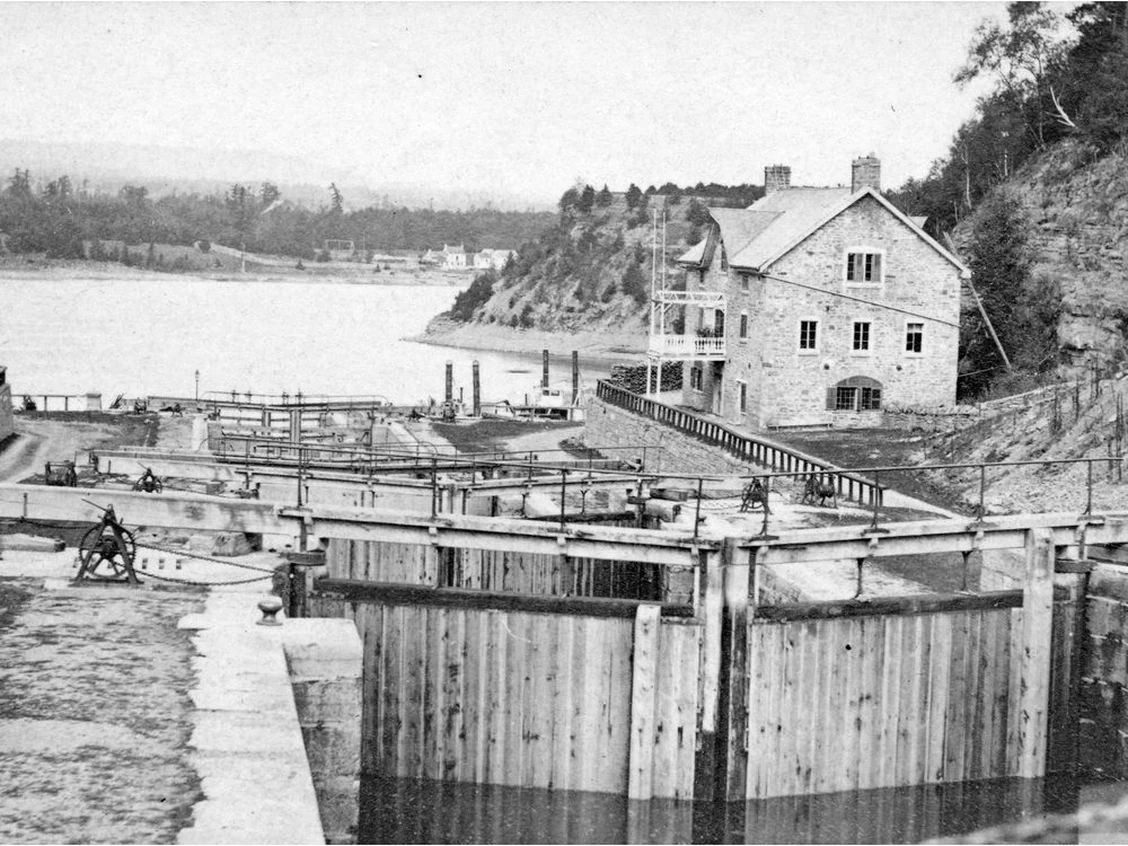
When Lt.-Col. John By arrived in the area in 1826, his first requirement was to construct a place for his canal design team of Royal Engineers and civilian employees to work. The Ordnance and Engineers Building would be By's command centre during six years of canal construction.
Completed in 1827, the three-story stone structure was located near the foot of the planned locks on the northeast bank of Entrance Bay. The second floor served as offices for the engineers with storerooms on the first and third floors. A later plan of the building, drawn in 1844, showed renovations to the storerooms. The number of windows on the second floor indicated up to 12 offices for the engineers and civilian staff. At this time, a similar-sized stone building was erected on the opposite side of the locks, housing the Commisariat (today the Bytown Museum).
The Board of Ordnance was responsible for all overseas fortifications, canals and other civil works used by the British military. The land reserved along both sides of the canal was called the Ordnance Reserve. The Board was also responsible for manufacturing arms and ammunition for the army and navy, and Colonel By had previously built their principal small arms factory at Enfield in England.
The corps of engineers was founded in 1716, initially officers-only, and known since 1787 as the Royal Engineers. A separate construction corps of carpenters, stonemasons, bricklayers, and other laborers, established in 1787, was known since 1812 as the Royal Sappers and Miners. The Royal Engineers, Royal Sappers and Miners and Royal Artillery were not part of the British army at that date. They reported instead to the Board of Ordnance and its Master-General, Henry Paget, Marquess of Anglesey. Colonel By named Anglesea Square in Lowertown after him.
Numerous paintings and photographs over the years show the Ordnance and Engineers Building and the roadway beside the locks leading down to it from Rideau Street. After the Canal was completed, the building continued in use to administer ordnance lands along the canal and their eventual disposal. From at least 1866 to 1875 it was the office of Lt.-Col. William Coffin, Commissioner of Ordnance Lands for the Canadian government. From about 1881 to 1899 it was used for storage by the Northwest Mounted Police.
In 1901 an embankment with stone retaining wall was built behind the Ordnance building to carry railway and streetcar tracks from the new Alexandra Bridge. It required removal of a corner of the building, which weakened the structure. After a few years use for railway storage, it was demolished in 1912 by the Canadian Pacific Railway.
All that is left today is a cement outline of the foundation on the east side of the locks and a historical marker.
Photo: City of Ottawa Archives, CA-025899
