LOST TO FIRE: SANDY HILL'S HERITAGE BATE HOUSE
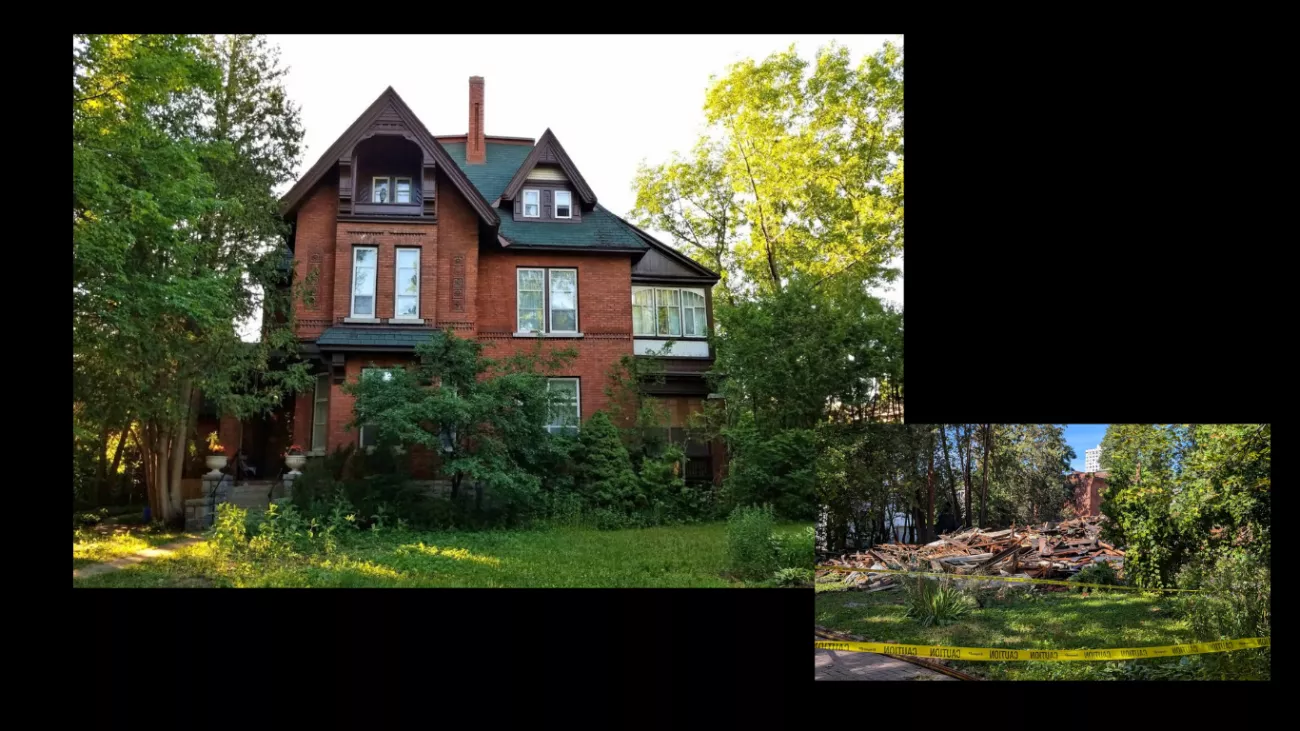
A fine example of Queen Anne Revival style architecture at 455 Wilbrod Street (corner of Wilbrod and Cobourg) was tragically destroyed by fire on September 19. It was listed as a Category 1 building in the Wilbrod-Laurier Heritage Conservation District of Sandy Hill, created in 1982 to protect an excellent example of a late 19th-century affluent residential neighbourhood, which also happened to be home to four Canadian prime ministers.
The large villa style homes that define the Wilbrod-Laurier HCD are associated with the development of Sandy Hill in the 19th and early 20th centuries and its association with the early development of Ottawa as the national capital. The HCD includes a mix of architectural styles for grand homes popular during the period. The Queen Anne Revival example at 455 Wilbrod spoke to that history.
Known as The Bate/Fenton House, it was built in 1895 for H. Gerald Bate, eldest son of Sir Henry Newell Bate. Gerald Bate died in 1934 and left the house to his daughter Marjorie (1893-1973), who had married William S. Fenton (1886-1970) in 1915. The Fentons were living in the house when Lieut-Col. Fenton died in 1970.
Sir Henry Newell Bate established a successful wholesale grocery business, then branched out to real estate, becoming a leading Ottawa entrepreneur. He was the first chair of the Ottawa Improvement Commission (now the National Capital Commission). In 1899 Bate founded All Saints Anglican Church, which he and his family supported over many years.
The devastating fire was reported at 10:24 pm on September 18 when firefighters found smoke and flames coming from the second floor and roof. The fire was under control by 3:20 am however the damage was so extensive that the building was demolished the following day. Fortunately, the building was vacant and no injuries were reported. The cause of the fire is under investigation.
