PAST MEETS PLAY: OTTAWA'S HISTORIC SPORT SPACES
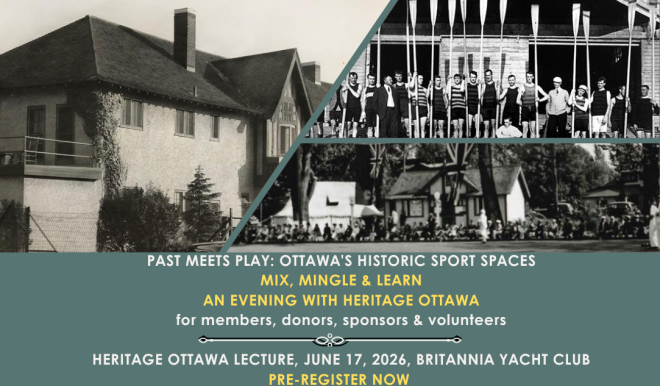
A SPECIAL EVENT IN APPRECIATION OF OUR MEMBERS, DONORS, SPONSORS AND VOLUNTEERS!
Join us for a special evening to Mix, Mingle, & Learn so we can properly thank you, our valued members, donors, sponsors and volunteers for your support of Heritage Ottawa and the work that we do. An illustrated talk, Past Meets Play: Ottawa's Historic Sport Spaces, with guest speakers will follow refreshments.
Britannia Yacht Club, Upper Deck, 2777 Cassels Street, Ottawa. Free parking on site.
Refreshments and time to reconnect begin at 6:30 pm. The lecture follows at 7 pm. This free event is by invitation only. Space is limited so PRE-REGISTRATION is required using the form below.
Be sure to check in upon arrival to pick up your ticket for a complimentary glass of wine, beer or soft drink.
Not a member yet? CLICK HERE to join.
PAST MEETS PLAY: OTTAWA'S HISTORIC SPORT SPACES
Our evening presentations will explore the fascinating history of sports and social clubs in Ottawa through five featured sites: the Champagne and Plant Baths, the Highland Park Lawn Bowling Club, the Ottawa Tennis and Lawn Bowling Club, and the Ottawa Rowing Club.
Heritage conservation consultant Sally Coutts will present on The Champagne and Plant Baths: History and Preservation Efforts. Both facilities opened in 1924 to address the lack of amenities in two predominantly working class wards of the city. The urban reform movement saw a growing interest in improving the lives of the working classes while encouraging cleanliness and healthy recreation. Both facilities are high style structures, providing an impressive civic presence. Sally will share the histories of these significant civic facilities and the efforts made to preserve them.
City of Ottawa Heritage Planners MacKenzie Kimm and Taylor Quibell will focus on the role lawn bowling, tennis and rowing clubs played in Ottawa’s sport and social histories. The clubhouses, boathouses and recreation areas reflect the evolution and rise of the popularity of these sports in Canada, and stand as remnants of the late 19th and early 20th century lifestyles of the emergent middle class. Their presentation will speak to how, through municipal heritage designation, the City is recognizing the importance of these local landmarks and their significance in Ottawa.
Sally Coutts has dedicated more than four decades to heritage conservation, working across federal, provincial, and municipal levels of government. Her career began in rural Alberta, where she managed a grant program aimed at restoring pioneer cemeteries. She later served as an architectural historian for Parks Canada. In 1990, Sally joined the Heritage Section of the City of Ottawa, spending the next 30 years as a heritage planner and contributing to a diverse range of conservation projects. After retiring in 2020, she founded Sally Coutts Heritage Consulting, completing three heritage conservation plans for the City of Ottawa. She now provides heritage planning advice to the Municipality of Mississippi Mills.
MacKenzie Kimm is a Senior Heritage Planner with the City of Ottawa, where she provides conservation expertise on heritage and planning applications, oversees the preparation of Heritage Conservation District Plans, and presents evidence before the Ontario Land Tribunal. She holds a Master’s degree in Architectural Conservation from the University of Edinburgh and in Urban Planning from McGill. As a life-long swimmer, MacKenzie’s love for sports has informed her professional and research interests, including her Master's major research project that examined the conservation of historic sporting facilities in the UK, and working on the designation of the Ottawa Rowing Club.
Taylor Quibell is a Heritage Planner in the Heritage Planning Branch at the City of Ottawa. In this role, she provides technical guidance on conservation projects, processes heritage permit applications, oversees heritage grant programs, and conducts research on heritage buildings. Taylor’s technical experience stems for her studies in Architectural Conservation and Sustainability Engineering at Carleton University, where she went on to obtain a Masters in Building Engineering. In her Masters she wrote her thesis on the environmental impact of office to residential conversions
