OTTAWA CELEBRATES BUILT HERITAGE & URBAN DESIGN
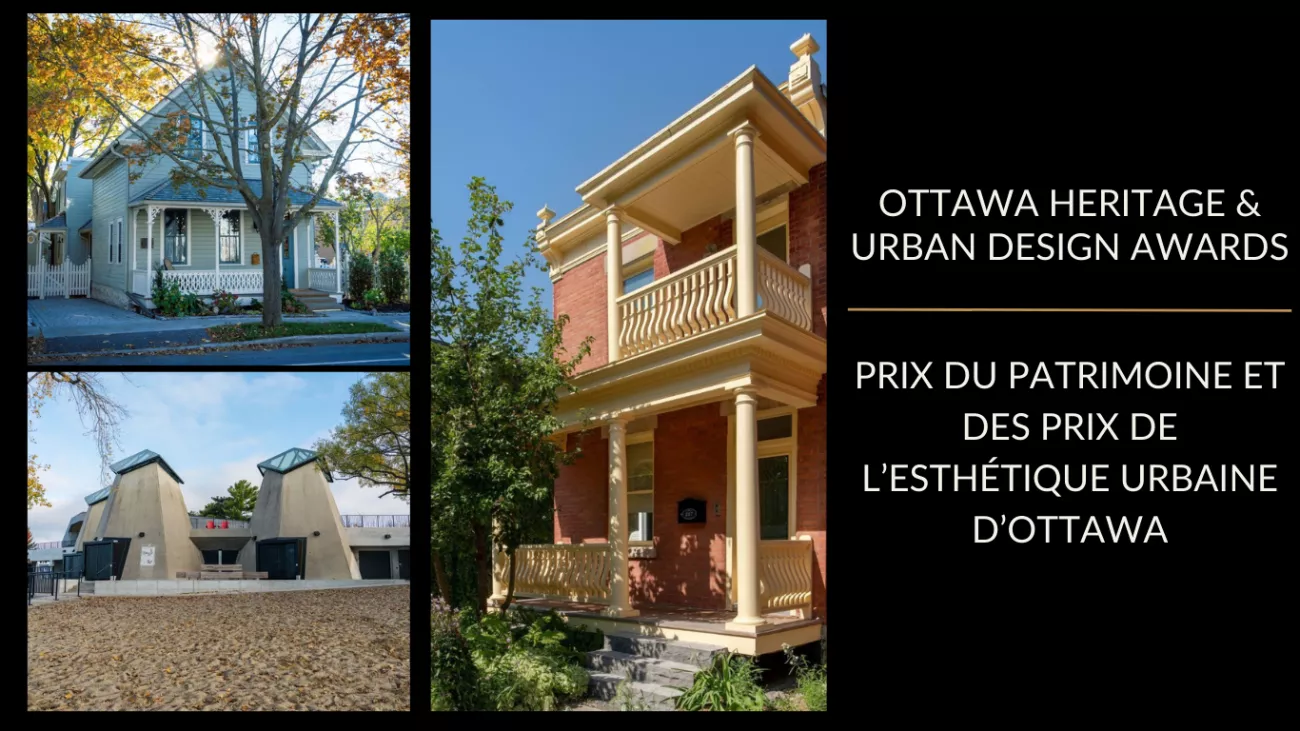
Heritage Ottawa was pleased to attend the 2025 Heritage and Urban Design Awards gala ceremony held at City Hall in November. The well-attended event recognized outstanding conservation and design for projects completed between 2023 and 2025.
The Heritage Awards are divided into three types. Those that are project-based recognize quality restoration work, sensitive rehabilitation, adaptive reuse of existing buildings, well integrated infill and additions, well-designed landscaping, and more. Student-led projects are awarded to a student of student team that attends a post-secondary institution and is enrolled in a heritage conservation-related program. Projects are based on the conservation of Ottawa’s built heritage and could be theoretical or studio based. And the David Flemming Community Heritage Award recognizes an individual or group who has made a positive impact on heritage conservation or has enhanced the community’s understanding of heritage in Ottawa.
PROJECT-BASED HERITAGE AWARDS
Pothier House (1902) for the restoration of its beautiful two-storey porch with curved balusters, detailed entablature, and galvanized finials and corbels. Located at 207 Cathcart Street within the Lowertown West Heritage Conservation District, the work was undertaken by Paul Denys of Denys Builds Designs Renovations.
Tubman House (1874) at 51 Crichton Street in New Edinburgh for the extensive restoration work that included repairs to the foundation, porch, windows, entrance, fence and landscaping of the one-and-a-half-storey historic house.
Stone Abbey is an infill development located to the rear of the landmark Southminster United Church, a prominent site overlooking the Rideau Canal, for the sensitive landscaping and use of mature trees to distinguish between the historic church and the new infill residential development.
Eco Infill Project at 280 O’Connor Street for its thoughtful integration into the Centretown Heritage Conservation District. Set behind two existing historic buildings, the new construction successfully echoes the materials, window patterns, and height of the surrounding area that respects the local character of the neighbourhood.
Westboro Beach Pavilion for the rehabilitation of the federally designated heritage pavilion towers originally designed in 1966 by Ottawa architect James Strutt. The project included the restoration of the glass roofs that once capped the towers and the introduction of artwork and a zero-carbon playground park.
River House, the former Ottawa New Edinburgh Club Boathouse on the Ottawa River, for the reinstatement of original wood siding, reuse and sensitive replacement of windows, and creation of new accessible pathways.
Chief William Commanda Bridge (1879), an important landmark in Ottawa due to its design, length, location, and history, for conservation work that included careful preservation of existing components with minimal intervention to the stone masonry abutments and piers, steel trusses, and bridge plaques. The new timber plank deck, steel cable railings, and light fixtures respect the heritage character of the bridge.
STUDENT AWARDS
Adaptive Reuse of Worship Spaces in Contemporary Heritage Cities: A Tale of Three Churches in Ottawa by Siyi Zhou centres on three case studies: All Saints Anglican Church, St. Brigid’s Roman Catholic Church, and Dominion-Chalmers United Church and offers insights into the processes involved in transforming and reusing the religious heritage sites.
Community, Kindness, Respect: Adaptive Reuse as a Means to Preserve Memory -- Le Monastère des Servantes de Jesus Marie by Alexandra Larose explores how adaptive reuse could be used to preserve intangible values in addition to material values, reimagining the spaces around and within the vacant monastery on the Ottawa River.
DAVID FLEMMING COMMUNITY HERITAGE AWARD
Kevin Ballantyne for creating two online platforms dedicated to the history and heritage of Ottawa using interactive maps showing Bygone Buildings, Railways, Street Name Origins and Fire Insurance Plans. He also created a YouTube channel, Forgotten Ottawa.
The award was renamed this year to honour lifelong heritage advocate in Ottawa, and past president of Heritage Ottawa, David Flemming.
For more fulsome project descriptions and photos CLICK HERE.
URBAN DESIGN AWARDS
Thesecond half of the ceremony saw the presentation of Ottawa’s Urban Design Awards to eight deserving projects in five categories: Urban Infill, Public Places and Civic Spaces, Urban Elements, Visions and Master Plans, and Student Projects.
For a full list of the winner CLICK HERE.
